Showing posts with label Smith. Show all posts

Saturday, November 15, 2014

Sepia Saturday: Farm labourers

Farms are very attractive, in theory. My mum and dad, Mavis and Angus, uncle and aunt to the kids in this story, had a dairy farm in Western Victoria and my mum's nieces and nephews lived in the city. We farm kids thought a rare visit to the city was very exciting and our cousins thought a visit to the farm was exciting.

Mum and dad loved to entertain the visitors. Dad especially would create fun activities for all to enjoy and mum would create big meals for everyone. My cousins have happy memories of those days long ago, in the last century, in the 60s and 70s. The Smith family drove from Adelaide, about eight hours, so it was quite an adventure. Our other cousin, Rex, only had to come from the nearby town of Portland but then moved to Melbourne about five hours away so he too had a bit of a trip.

In the 1970s my husband and I bought a small farm nearby and ran a few sheep. On this particular day in about 1976 the lambs needed to be drenched for worms. As our sheep yards at that time were still in a state of disrepair and lacked a narrow race it was a bit of a task to catch the lambs in the rather large enclosures, so my dad thought it would be helpful if he brought his visitors over to help out. Dad, Uncle Arthur, the three young Smith cousins (Julie, Robert and James) and their friends (Michael and his two girls) arrived and were put to work.

It was pretty funny. The kids, especially the girls, were reluctant to get dirty. Very reluctant. And the lambs were lively and hard to catch and hard to hold if they were caught. There was a lot of squealing and the kids got very dirty. But we got the job done.

My cousins still talk about that day.
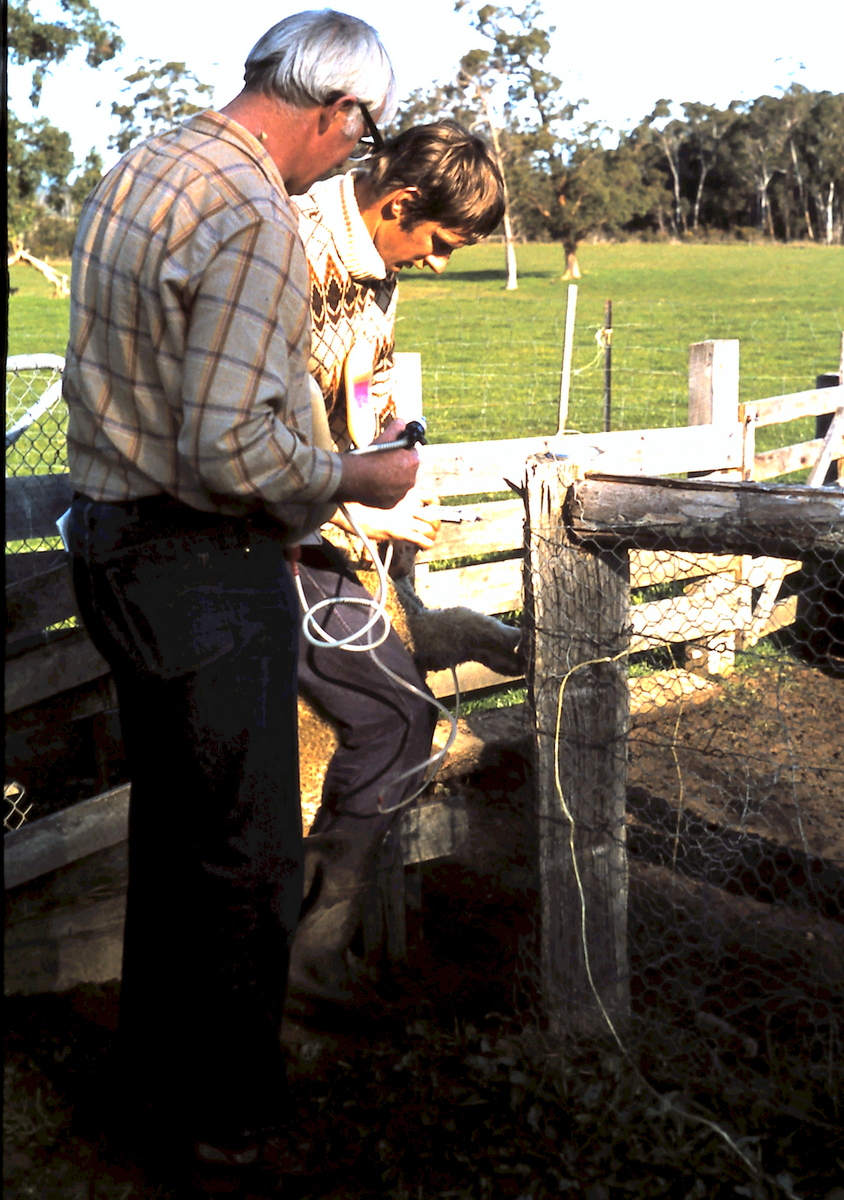


This blog is in response to Sepia Saturday's theme photo that shows a lady being carried across a stream. I didn't have any photos of a gentleman helping a lady but I did have these photos, scanned off slides, showing people helping out on a farm. They aren't sepia but they are nearly 40 years old. Yet it seems like just yesterday! This is for you, Julie.


Saturday, October 25, 2014

Sepia Saturday: Constable Ephraim Smith

I've written about Ephraim Smith several times in this blog. He was my grandfather's grandfather.

Ephraim Smith
Ephraim and his wife, Elizabeth, migrated from England to Australia in 1852. I've written about him selecting land at Dunmunkle (here), about his broken leg (here) and about his arrest in 1851 for being involved in a drunken brawl after a cricket match in his village (here). The last episode amuses me because he led a sober Christian life, raised a large family and worked hard as a farmer and gained the respect of all in his district. And it amuses me because three years after the brawl, in another country, he was employed as a policeman for a few months.

I was reminded of this when I saw the theme photo for this week's Sepia Saturday.


Victoria Police was formed in January 1853 nearly 20 years after the colony was first settled by Europeans. During those 20 years there had been seven independent police forces and the uniform of Victoria Police was influenced by previous uniform styles. The single-breasted tunic was navy blue with a row of white metal buttons and they wore navy trousers in winter and white in summer. They wore a black leather tschako-style cap. So the uniform was probably similar to that worn by the 'men in blue' in the theme photo. Ephraim signed on as a constable in July 1854 and would have had to purchase his own uniform.

Ephraim was 28 years old and had three small sons. The family was living in the Warrnambool area and that's where he served. He left the force after six months, for reasons unknown, and after that time always worked as a farm labourer and farmer.


Sunday, June 8, 2014

George Smith visits Glentromie and the Spanish Mission

Part seven. Great-grandfather George Smith's diary continues. He leaves Perth to spend several days at Glentromie Station. He seems to have been impressed by the farming country and considered going farming there himself.

5 July 1889 Left for Glentromie. Travelled until quarter to two next morning at Bindoun [Bindoon].
6/7 Left at 8.00 for Glentromie arriving at two in the afternoon. Strolled around the homestead.
7/7 Strolled around. Went riding and turkey shooting and in the afternoon went to the Spanish Mission [New Norcia]. A very interesting place. Our party was showed all over it by the Bishop. There was on the mission 50 monks and 300 natives.
9/7 Morning went to see the station men plowing the ground was very wet but the crop that was in looked well. I and Mr Alpine left for Gilford [Guildford] 11 a.m. came to ... and put up for the night. A pleasant ride of twenty-eight mile.
10/7 Left Wellese [?] at seven a.m. on a fifty mile journey. Passed through some very nice country. Saw some good land which was sold in 1887 for 15/- an acre. Arrived in Gilford 6 p.m. put up for the night at Jutes Hotel. Went to a concert in the evening.
11/7 Started for Perth on the 8.30. Visited Henry Wright, also the government printing office, got the land regulations.


Towns mentioned by George in his diary.
Glentromie is about 120 km from Guildford. Bindoon is about 70 km. George doesn't say in his diary how he travelled. Was it by coach? Was there a train line? For the journey back to Perth he talks about 'a pleasant ride' so he may have had access to a horse.

Why did George go to Glentromie? Maybe he wanted to check out the possibilities of farming there, maybe he'd been talking to someone, maybe he just wanted to see the Spanish Mission. As described in the article below, Glentromie was a very large, innovative and efficient property and the owners welcomed visitors.


The Daily News 18 April 1887
In fact, McPherson died that year, 1887, and the property was found to be heavily mortgaged and had to be sold. Walter Padbury bought it and the new manager was Charles Davidson from Victoria who was married to the new owner's niece, Amelia, so they may have been in residence when George visited. According to this site the homestead still exists. The homestead complex was placed on the state's heritage register in 2013.

'Glentromie' entrance off the Great Northern Highway [Google Maps]
The Spanish Mission at New Norcia is also mentioned in the article. It still operates today and is a very popular tourist spot. It was established in 1847 as a Benedictine Mission and many of the old buildings remain. Many of the monks were Spanish and Bishop Rosendo Salvado's  "original vision was to create, among the indigenous peoples of the Victoria Plains, a Christian, largely self-sufficient village based on agriculture. However, after the decimation of the local populations by introduced diseases in the 1860’s, he concentrated his activity on giving a practical education to the indigenous children who were brought to New Norcia from all over the state. Like other missionaries of the nineteenth century, his aim was to ‘civilise and evangelise’ according to the European ideals of the time, but he did so with sympathy for indigenous culture that was rare in his day." The quote is from New Norcia's website.

George says in his diary that he was shown over the mission by the Bishop so I presume that would be Bishop Salvado. 
Bishop Salvado
One of the many buildings on the New Norcia site.
There is an image of the mission in 1885 at the ANU - I can't reproduce it here but you can go and view it.

To be continued. George goes back down the line to work along the Great Southern Railway.

Wednesday, June 4, 2014

Trove Tuesday: George Smith attends court in Perth

Part six. The diary of George Smith continues. Great-grandfather George has left the work gang on the Great Southern Railway and travelled by train to Perth.

1 July 1889 On the train for Perth and very thankful to God for his Grace. Stopped at Pingelly Station road up from Broome Hill with witnesses on a murder case they all being drunk. At Pingelly worked one half day sinking trial holes for a dam.
2/7 Started for Beverley 8 A.M. arrived at 9 P.M.
3/7 Left Beverley for Perth 8 A.M. passed through York and Guildford arriving in Perth at 2 P.M. rode with farmers most of the way. nearly missed the train at Guildford. The country the Darling Ranges between York and Guildford very pretty. Perth also favorably  impressed me.
4/7 Called on Henry Wright. Attended the morning Perth Sessions. Afternoon went to Fremantle had a look around its jetty's and streets returning with the six o'clock to Perth.
5/7 Attended the Session. Jury returned a verdict of manslaughter.

Fremantle, 1898
I wondered why George would have gone to visit the Perth court sessions. He doesn't provide any names in his diary but a search through the newspapers on Trove gave me a few answers. It turns out that the drunk witnesses from Broom Hill George had met on his trip to Perth were involved in the case he went to see. It concerned an altercation (that ended in a death) among some members of a gang collecting sandlewood along the railway line near Albany. George had probably heard or read about the case before he met the witnesses and then decided to attend the court sessions.

Western Mail, 20 Apr 1889
Old Supreme Court, Perth (now the Burt Law Museum)
The Perth newspapers published the proceedings of the court case in great detail but I'm only posting the summary here. The sentence of 15 years for manslaughter seems a bit tough to me because the sandlewood cutters were all drunk at the time and gave conflicting witness accounts at the time. And, according to George, were still drunk three or four months later on their way to the trial!! I hope they had sobered up before they attended court. It would be interesting to know what happened to William Kelly after he got out of jail.

The Inquirer and Commercial News, 10 Jul 1889
The Argus, 8 July 1889
And for our George? He left Perth the next day to explore some other areas of Western Australia. 
To be continued.

Friday, May 30, 2014

Sepia Saturday: Glorious hair


The theme photo this week's Sepia Saturday is of a woman with long hair, very long hair. She has been posed so that the full glory of her hair can be seen to best advantage. That particular pose is not unusual in the old photos. It must have been every young girl's dream to have beautiful long hair.

Phil's great grandmother Maggie was a young teenager when this photo was taken. Her waist-length hair is smoothly tied into several bows but I imagine she wore it in plaits most of the time ...

Margaret McKernan
...like my mother when she was young. There she is at left in a school photo. Her older sister, Betty, is second from the right. All five girls have their hair in plaits. And all the boys have dirty knees! (Lawler is a small rural community east of Minyip in Victoria's Wimmera area and this is the entire school.)

Lawler School, 1934
There is a family story that when Betty and Mavis were very young Betty cut Mavis's plaits off for some reason. In this photo Mavis has short hair so maybe the story is true.

Mavis and Betty Smith
And finally, just for fun, here's a photo from the Genealogical Society of Victoria's collection. It was taken in the 1920s and is of a lady using a garden hose to wash her long hair.

Unknown lady washing her hair in a garden. {GSV collection]

Monday, May 26, 2014

Trove Tuesday: In which George labours on the line

Part five. The diary of George Smith continues. It's May 1889 and George is still working as a labourer on the Great Southern Railway that was being constructed between Albany and Beverley in Western Australia.

Men using timber sleepers to construct the 

Uralla Railway Line west of Roma, ca. 1918 [QldPics, bonzle.com]

1/5 Weather very showery, cold at nights with inclination to freeze. Very much amused at my mate giving me some reminiscences of old Ireland and some ballads.
2/5 Plate layers in camp fixing line and lifting siding to ballast pit.
3/5 Dressing & trimming formation. Visited by inspector of repairs.
4/5 One month on repairs 8-6-0 due. Beautiful day. Went to next camp for mutton. Weight of sheep 28 lbs. Longing to see a Christian.
5/5 Usual routine, usual work.
7/5 Loaf of bread stole from Ned McGuinnes's tent attributed to two travelling hawkers.
9/5 Usual work. Michael Courtney's tent robbed, loaf of bread stone. My tent robbed, piece of bacon & some mutton stolen.
10/5 Jack McCarthy put on. Went to Taylors in the afternoon.
11/5 Ten pound of pork stole from McCarthy's tent, suspicions on Bobby Hunter.
12/5 Shifted two tents & erected two chimneys.
13/5 Lifting and pulling the line.
14/5 Burning off scrub.
15/5 Pay day. Paid 8-6-6 twenty two and a half days. Loading rails and crossings with the next gang.
16/5 Went to Narrogin with McCarthy on the trolley, distance 16 miles, for stores. Could get no fresh meat so have to do without it. Wrote home.
17/5 Cleaning drains
18/5 Heavy showers. Miller went along the line inspecting.
19/5 Lang ramble into the bush, reading etc.
20/5 Working on the line. Evening listening to ballads and ghost stories.
21/5 Got word from Inspector Reardon that we would have to shift in a day or two on account of the length being made longer a mile being put on to each of them.
22/5 Thinking of leaving the repairs and going to Glentromie. The line has to be opened on June 1st and intend then to go down to Albany and see about it.
23/5 Shifting camp six miles near Beverley. Made two trips of it, shifting three frame tents. Pushing them up on a one in sixty grade on the trolley hard work.
24/5 Morning fixing up camp, afternoon went to Taylors with trolley 12 miles for meat, got half sheep 11 lb. First saw the notorious Fanny Flay.
25/5 Working close to next gang. One of them had his bed clothes pulled off him and took outside, the door of his tent being closed. Rainy day washing, baking the food, fixing tent. Living with Ned in a twelve by two.
27/5 Dispute between the ganger and Ned McGuinness. hasty words. the dispute arose out of which of the two owned a certain kerosene tine bucket. Ned stopped in all day, went out next day.
28/5 Saw a regular overland troop going east, six niggers and a gin all mounted on three pack horses & a white man. Rather a drool looking lot.
29/5 The inspector came along and altered our length us to shift a second time to our annoyance. Ganger received news from his wife. She said she was coming over.
30/5 Up at daybreak packing up. Shifted to the 66 and a half. At it all day. I vexed the ganger very much in wanting to let the trolley run down a steep grade.
31/5 Went to Taylors got 12 lb pork, half pound of tea, 6 sugar.
1/6 On clay banks the line sinking working hard. Afternoon fetched a load of boxes on trolley from the old camp.
2/6 Putting floor in tent.
3/6 Lifting the rails on each of the bridges one inch high. Three hours rain, stopped in tent. Line opened from the ninety to Beverley, a train through & back once each day.

West Australian, 31 May 1889
4/6 The boss and old Ned at it again about packing the sleepers. Sam Diver with us for a night. He had been on a spree for a fortnight and was in the horrors.
5/6 Climies Cart came with the stores. Fetched letters and newspapers. Was glad to hear that all was well at home.
6/6 Bought 16 shillings worth of Ned's stores. He left with the cart down to the one hundred and nineteen. He left the tent. While we were away took six lb onions from my tent & dish and some bags from Courtney.
7/6 Visited by the inspector of repairs. Was told the length we left was very bad in parts. Gave letter to him to post.
10/6 Rainy day. Pay train came at eight o'clock at night. Grand 20 chain chase after it. Received 24 days pay 8-18-0. Ganger one pound short in his pay.
11/6 Began a six chain general lift and decided to go to Narrogin on the morrow for stores.
12/6 Road too bad. Put off the trip to Narrogin. In rainy weather the banks get soft and the weight of the train puts the rail down in places and if they was not lifted and packed they would put the train off.
13/6 to 19/6 Diary pages missing

Railway gang [Image H2002.106/266 SLV]
20/6 Another hand put on, W Geary a Colonial, but as usual a swearing cursing navvy. Inspector passed up and found fault with the length. Said it was very crooked.
21/6 Full handed again but McCarthy said he would not come out again if he had to work such a heavy lever.
22/6 McCarthy stopped in having a very bad cold the result of the booze.
23/6 Went to Blakes camp and fetched back Diver to fill Jack's spot.
24/6 The Diver and I batched together. He is a sailor cove with plenty of funny yarns but abominably smutty.
25/6 Playing cards all evening and did not feel right, neglecting praying & spiritually uneasy.
26/6 Thought of leaving & going to Perth. Bad company has an awful influence.
27/7 Another man put on, Black Peter by name. The usual character. Cards again. Told Courtney that I would leave. Sorrow all round. Got my time and gave stores to Diver.
28/6 Started for Albany from the Arthur River siding.

Albany Railway Station, Western Australia. It was constructed  in 1889
the same year that the Great Southern Railway was opened. [Postcard]
To be continued. In the next installment George goes to Perth.

Tuesday, May 20, 2014

George Smith the dictator


Part four. The diary of George Smith continues. It's April 1889 and George is still working as a labourer on the Great Southern Railway that was being constructed between Albany and Beverley in Western Australia.

Bush camp 1900 [Museum Victoria]

19/4 G Bow in our camp. Paddy Fits and McGloun ... their tucker and cans of ... because ganger wouldn't wait for them to get water in the morning at 5 past 8 they stopped work all day.
20/4 They used threatening language, was going to half kill the ganger, he being very frightened of them.
21/4 Sunday. Helped build tent for the ganger. Went over to the rowdies camp and talked blood and hair. Cowed them a little.
22/4 The rowdies done a lot of tongue work giving a lot of abuse to Courtney. Got off to our work all right. Asked guidance. Live peaceable with all men as much as possible.
23/4 Rowing again. Urged Courtney to hit McGloun couldn't get him to go for him. The ganger would go for police protection but persuaded him to not go and if the rowdies said or done anything I would knock ... out of them. Quieted his fears a little.
24/4 Peaceful. Saw Reardon inspector of repairs. Pleased with our work and said he would get us two fresh men.
25/4 Cutting scrub now with Bobby Hunter. Was pealed off to give him a hammering for language used. Was vexed by my very unchristian action.
26/4 Cutting scrub. Peace in the camp owing to me I believe holding the office of dictator.
27/4 Burning off. Rehmatics [sic] very bad in the shoulders. Rowdies still quiet.
28/4 Sunday. Washing, baking, went to a farm eight mile off for mutton. Got one fresh hand E McGinnis. Rowdies cleared out in the ...
29/4 Cutting scrub. Afternoon a terrific thunder storm. Sent letter home for Clissie storekeeper.
30/4 Clearing on the line. Becoming reconciled to my lot in a measure. Beginning to think of visiting New Zealand and after, God willing, home.

To be continued.

Monday, May 19, 2014

Trove Tuesday: In which George is a railway ganger

The story of George Smith's adventure continues. You can see the first two installments here and here.

George Smith travelled on a coastal steamer from Adelaide to Albany in Western Australia and headed up the line to find work on the construction of the Great Southern Railway. Before the Fremantle port was built Albany was the main deepwater port for Western Australia and it was over three hundred miles from Perth. Construction of the 241 mile line was started at both Beverley (in the north) and Albany (in the coast) in 1886 and the line was opened in 1889.

The Argus, 4 June 1889
George found work in a gravel pit at first and then as part of a gang repairing the ballast and cutting scrub on the line. He was a devout Christian and found the conversation and behaviour of his workmates rather shocking. He wrote in his diary every day.


31/3 [1889] Arrived in Western Australia, Albany, and thought it a very pretty place.
3/4 Went up 190 mile to 196 gravel pit. Slept out all night. Rained at four o'clock in the morning. Suffering with a violent cold.
4/4 Engaged myself to work in the gravel pit 9 shillings per day. Went to work after dinner after pitching tent.
5/4 No coal for engines. No work in the morning, worked afternoon filling trucks. Thought I would have dropped for a while filling the last one from exhaustion. Cold no better.
6/4 Worked all day. Felt better. Thinking about giving it up.
7/4 Told I wasn't wanted in the pit. I engaged to go line repairing at the 165 at 7/6 per day.
8/4 Started for the 165 cap on the ballast train. Came to ? 14 mile off of it, started to walk the rest it, carried my things two mile, come to repairers, was trollied down. Camped at Godfreys.
9/4 Trollied down to 165 by Godfrey. Pitched tent in the morning, went to work in the afternoon. Thought it easy work. Thankful to God for his goodness.
10/4 Cutting scrub along the line with bill hooks. The country sandy and scrubby with plenty of poison weed called York Poisoned Weed.
11/4 On repairs packing the sleepers, equalising the gravel and filling the line. Shocked at the filthy conversation of the wicked.
12/4 Made my first batch of bread being the best bread on the camp. Any amount of rats in the tent at night.
13/4 Not very well being very tired at night. Took medicine.
14/4 Sunday. Refixed tent, washed my clothes, baked bread, took physic very feverish.
15/4 Felt well. Found out that my three mates Michael Courtey, Paddy Fits and Paddy McGloun starting mess. Got a supply of goods, tinned milk, preserved fruits, potatoes &c. Thankful.
16/4 Fell in with Bobby Hunter kangarooing. Thought him a queer card with his dogs & gun & lonely life.
17/4 With the flying gang ballasting the line with some Victorians. Getting into the work splendidly.
18/4 Still with gang re ballasting. Worked very hard all day ...


Railway trolley. [Museum Victoria MM4926]
Railway camp, Western Australia [Museum Victoria 158140]
To be continued.

Thursday, May 8, 2014

George Smith is a tourist in Adelaide

While George Smith was in Adelaide on his way to Western Australia (see previous blog) he had time to visit several tourist attractions.
19/3/1889 Went out to see the Gully Water Fall in the Mt Lofty ranges south of Adelaide and was much delighted with it and the rugged scenery around and the sea at sunset looked like an immense looking glass oval shaped at my feet. 
20/3/1889  Went out to see the celebrated sewerage farm North of Adelaide and was much delighted with it and on the farm was a crop of sorghum cutting sixty tons per acre also fruit trees and vegetables of great variety also ensilage pits in full work. Evening Chapel Grote St. 
21/3/1889 Stayed home and read Green and Walkers debate on Christianity versus Spiritualism. Afternoon went to see the model of the famous Strasburg Clock and Exhibitions Buildings.
 The first one was a waterfall. It's now called Waterfall Gully and it's 8 km east of Adelaide.

First waterfall, Waterfall Gully
The second was a sewerage farm! But remember, George was a farmer so he was very interested in the crops grown at the farm as well as the technology. And he wasn't the only visitor. Adelaide was the first in Australia to establish a waste-disposal treatment system so people from all around Australia as well as international visitors called in to check it out. It was opened in 1881.

A history of Sunnybrae, Donovan & Associates, 1993
And the next day George went to see a clock. The Strasburg Clock was on display at the Exhibition Buildings in Adelaide and is now in the Powerhouse Museum in Sydney where it is one of their most popular exhibits. George was impressed as well and he made notes in the back of his diary about aspects of its design. It had been built in 1888 by a young Sydney clockmaker,  Richard Bartholomew Smith (no relation), as a model of the famous clock in Strasburg Cathedral, Germany.

Strasburg Clock, Powerhouse Museum, Sydney
A description of the working of the Strasburg Clock
 (Teacher notes, Powerhouse Museum)
South Australian Advertiser, 29 March 1889
Finally, I decided to search for the Green and Walker debate on Christianity versus Spiritualism mentioned by George. And, to my surprise, found several references. The debate was held in Melbourne in 1878. George was a member of the Church of Christ so probably supported Mr Green's arguments.
Nineteenth Century Miracles, E H Britten [Google Books]

Monday, May 5, 2014

Trove Tuesday: In which the Adelaide Coffee Palace catches fire

In 1889 George Smith (William George Smith) was 25 years old, a wheat farmer at Dunmunkle  near Minyip in the Wimmera. His parents also lived at Dunmunkle and he was single, with five brothers and six sisters.


George's childhood was spent at Wangoom near Warrnambool on Victoria's coast and when he was about ten years old the family moved 250 km north to Dunmunkle. In 1889 he decided to go to Western Australia to find casual work, left home in late February and arrived back in early November. George wrote a diary while he was away but never said why he went or why he went to Western Australia. Maybe it was to earn more money, maybe it was just a bit of adventure before he settled down.

I decided to check the Trove resources against the diary entries and it has proven to be an interesting exercise. George travelled from Melbourne to Albany via Adelaide on coastal ships and then worked on the new Great Southern Railway being constructed from Albany to Beverly east of Perth. He also had time to visit a few tourist spots in the Adelaide and Perth areas.

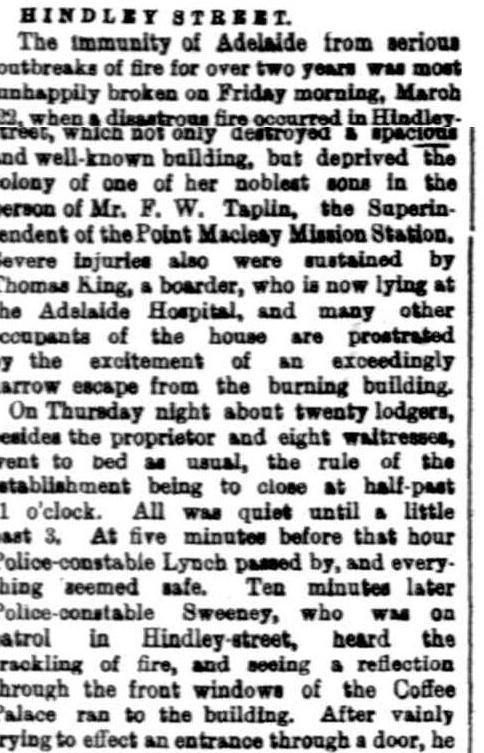
For this Trove Tuesday blog I decided to check just one fact. George was staying in Hindley St, Adelaide and one night his sleep was disturbed when there was a fire in the Coffee Palace across the street.
22 March [1889]
Early morning three a.m. scared with the alarm of fire and found it was the Adelaide Coffee Palace all on fire square opposite my bedroom window. One of our men suffocated to death another had his back broken and is dying recovering.
South Australian Register, 22 March 1889
Adelaide Fire Brigade, horse-drawn equipment and squad of firemen c1880.
[South Australian Library B28395]
The report that appeared in the paper the following day was more detailed. The cause of the fire at the Adelaide Coffee Palace was unknown but there was one fatality, Frederick W Taplin, and one badly injured lodger, Thomas King. The Adelaide Fire Brigade appeared promptly and the fire was quickly dealt with and restricted to the front of the building.

South Australian Register, 23 March 1889
From the map included in the report above it is clear that the Adelaide Coffee Palace was located in Hindley St next to Club House Lane. The building is no longer there. Coffee Palaces originated in the temperance movements at the end of the 1800s and offered accommodation and refreshments, designed to compete with hotels.

It turns out that Frederick Taplin, the man who died in the fire, was quite well known. He was in charge of the Aboriginal mission that his father had started at Point McLeay on Lake Alexandrina on the Coorong. There was an inquest into his death and a family notice of his death published in the papers. More details (an obituary almost) about Mr Taplin can be found at Trove in the South Australian Register 23 March 1889.

Evening News, Sydney (29 March 1889)
South Australian Register, 3 April 1889
There was a report of the fire published in a Western Australian newspaper. It provides a few more details.

Daily News, Perth (25 April 1889)
In May there was an auction of the furniture and effects of the Adelaide Coffee House.
The Advertiser, Adelaide (8 May 1889)
Great-grandfather George left Adelaide a few days later and sailed to Albany. That's a story for another day.

LinkWithin

Related Posts Plugin for WordPress, Blogger...