Showing posts with label Phelan. Show all posts

Saturday, June 25, 2016

Sepia Saturday: Safe in the arms of Jesus

Any family historian worth their salt has a collection of family photos and a high percentage of those will be of babies. I have quite a few, and fortunately most of the subjects are named.

I also have a collection of 'found photos', purchased at markets or on the web, and most of the babies in the collection are not named.

This week's Sepia Saturday theme photo is of a stock photo of a nursery with baby in a bassinet, mum (perfectly groomed and in control) reading a book, several soft toys on the furniture.

The matching photo I've chosen is not of a bassinet, it's not of a mother or story time and it's not of a nursery or politically incorrect soft toys. But it is of a baby. And he does have a name.

Glad with Allan  Phelan, Mitiamo 1927
Allan Phelan with Glad, two of his aunts and an uncle, Mitiamo 1927
Allan Phelan was born early in  1927, the third child of Roy and Annie Phelan. The family lived at Mitiamo, a small town in central Victoria. A local girl called Glad was employed to help Annie look after Allan and his two older brothers. These two photos of young Allan were taken in Mitiamo and they are the only photos we have of him. He died at the age of ten months of 'gastro', some sort of gastroenteritis that causes vomiting, diarrhoea and dehydration. These days it is rarely a fatal illness.

The Argus 1 Nov 1927
Allan was buried at Panoobamawm Cemetery (Pine Grove), a rural area east of Mitiamo where his mother lived when she was young.


I'm sure there are some happier stories over on Sepia Saturday's webpage.

Sunday, March 6, 2016

Sepia Saturday: Monumental steps

This post is in response to the Sepia Saturday's theme photo. I couldn't find any wheelbarrow photos so I've elected to look at the steps leading up to the fountain.


It must have been about 1962 when the Phelan family had a holiday in Canberra, Australia's capital. There was a lot to see. From the snapshots I can see that they visited the War Memorial, the old Parliament House and the Australian-American Memorial.

Family on the steps of the War Memorial, Canberra

War Memorial as it is today. It was opened in 1941 and houses a significant museum.

Family at King George V Memorial near the old Parliament House, Canberra
King George V Memorial as it appears today. It was commissioned in 1936 and constructed
 in the workshop but the war intervened and it was not unveiled until 1953.
The Australian-American Memorial, Canberra
The Australian-American Memorial on the
60th anniversary of the opening by Queen Elizabeth 2 in 1954.
It was built to commemorate the role of the US in the Pacific region in World War 2.
It is topped by an American Eagle 11 metres high.
Canberra today is a very beautiful city with the national war memorial, art galleries, parliament, botanical gardens, a large lake and other special sites. It's a planned city, built from scratch, but that's a whole other story.

I suggest you see what other bloggers have contributed over at Sepia Saturday's webpage.

Saturday, July 25, 2015

Bondi Beach

These four photos are in a Phelan family album. It's Bondi beach, Sydney, some time in the 70s I think. Bondi isn't in our patch so it must have been a holiday. I suspect that the photographer didn't even venture on to the beach because the photos appear to have been taken from a car park, and probably on the same day. They probably just went to have a look at the famous beach. Nowadays about three million people a year visit the beach - but not all at the same time fortunately. On a warm weekend in summer you might have to share with only 40 000 other people.

Coastal New South Wales is almost like a foreign country to us because we never visited when I was a child growing up in the neighbouring state of Victoria, and my husband's family was the same. If we wanted a day at the beach or a holiday on the coast we went to one of the numerous sandy beach towns along the south coast of Victoria. And we never saw crowds like this. Sometimes we had the long stretches of sand to ourselves.

One disadvantage of our beach visits was that we didn't have surf lifesavers watching, we didn't have to swim 'inside the flags' (note the red and yellow flag on the left of the first photo), but luckily none of us ever had a mishap in the ocean. This beach is the home of the first lifesaving club, established in 1907.

I've never been to Bondi. Should an Aussie admit to such a thing?

Bondi Beach
Bondi Beach and famous Bondi Baths built in 1931.
The baths are saltwater and tidal and have a heritage classification. In fact, the whole beach has a heritage value. The baths are also the home of the Bondi Icebergs, a club for people who swim there throughout the year.


Bondi Beach
This photo was taken on a different family holiday at Mission Beach in Queensland. Warm days and kilometres of sandy beach to share with ... hardly anyone else.

Mission Beach, Queensland. 1990s
This post is in response to the theme photo, a postcard of Bondi as it used to be. You can see more responses over at Sepia Saturday. Or you could pack your bags and head downunder in time for summer.


Saturday, July 4, 2015

Sepia Saturday: The catch

The catch
This photo fascinates me. I look at the hat sitting on the fencepost, I look at how far apart the couple are standing, I look at how thin people used to be, I look at the string of pearls around the lady's neck, I wonder about the circumstances of the photo.
I don't know who took the photo or who the subjects are because it is in an album that was donated to the Genealogical Society of Victoria. I think I can safely say that it is Australian, probably Victoria and probably in the 1920s.

We don't have many fish or fishing photos in our family albums even though it's an activity that a number of relatives enjoy. None of our recent ancestors were professional fishermen. There are one or two photos of fish being held aloft like the photo above but the one I'll publish here is of brothers Neil and Doug Phelan with their children at Port Fairy where Doug was a teacher. The fish were caught in the Moyne River from a small wooden boat with an outboard motor. Doug was, and still is, an avid fisherman. A fishing expedition on the coast was a grand adventure for a lad from inland Victoria - my husband doesn't remember this particular day but he does remember that he enjoyed Uncle Doug's boat and boating.

Fish caught at Port Fairy about 1956.
Port Fairy is a delightful small town on the south coast of Victoria, a very popular spot. The residents are proud of its history and run several world-class music festivals each year. And it's still a great spot to catch a fish or watch others trying to catch a fish. Or grab a feed of fish and chips to eat beside the river.

Moyne river, Port Fairy c2013.


This post is in response to the Sepia Saturday's theme photo of a fish drawing in the Smithsonian Museum. 


Sunday, June 7, 2015

Sepia Saturday: Entertainment

The theme photo for Sepia Saturday is of a chess game in progress but I can't match that. I don't know why we don't have any photos of game-playing because we spent a lot of time over school holidays playing Monopoly, Scrabble, Squatter and card games. Maybe our parents were so pleased to see us 'occupied' they were themselves occupied elsewhere.

But I do have several from the next generation. Here's our son Glenn with his friend David setting up patterns in a game called Domino express.

Glenn and David's Domino Express setup
And on one of our numerous family holidays beside Lake Charm near Kerang someone must have dug out an old cribbage board. This one is a triangle so three people must have been able to play. I wonder who knew the rules?

A cribbage game at the lake.
So, back to the theme photo. The chess player is a musician so in a very obscure link to that I'm including this photo of my mother-in-law, Shirley, holding my husband as a baby late in 1948. 

Shirley Phelan with son Philip, 1948.
Now, look at the background. There's a poster advertising a film night on 16 December. The family lived in the small town of Mitiamo and there wasn't a theatre so they must have used a church hall. 

The two films are The Dark Tower, a British thriller starring Herbert Lom, Anne Crawford, David Farrar and Ben Lyon. It's about a hypnotist who worked in a circus and held a trapeze artist in his spell. The other film is The Time, the Place and the Girl, an American musical starring Dennis Morgan and Jack Carson. Judging by this review in the New York Times at the time it was forgettable so I wonder if the citizens of Mitiamo enjoyed their night at the pictures (as we used to call it).

MOVIE REVIEW

The Time the Place and the Girl (1946)

THE SCREEN

Published: December 27, 1946, New York Times
That same old backstage story which the movies have been using for years about the romantic but impoverished young fellow trying to put on a musical show has been dusted off by the Warners, given an Arthur Schwartz-Leo Robin score, dressed up in Technicolor and called "The Time, the Place and the Girl." But even with those expensive trimmings this new picture, which came to the Strand yesterday, is but middling entertainment for the kids who stomp to swing.
Again it's the fault of the story, a hackneyed and mirthless affair in which a handful of farceurs and musicians clattered about for an hour and two-thirds. There are noisy and gawking Jack Carson, Dennis Morgan and Janis Paige representing that element of show people who have a lot of brass but no coin. There are Martha Vickers and S. Z. Sakall playing a concert artiste and her nice grandpa who get mixed up with these bunco-steerers. And there are others who drift in now and then.
Some of Mr. Carson's humors, while not particularly inspired, have a certain low-brow vigor in them. And a couple of the songs—notably "Oh, But I Do" and "A Gal in Calico"—are pleasant and passing well done. Miss Vickers, though not a Judy Garland, behaves in a lady-like way, and Mr. Sakall still manages to draw laughs by simply shaking his jowls and rolling his eyes. But the combined and elaborate efforts of everybody, including LeRoy Prinz, who arranged the fancy stuff, have resulted in one of those pictures that you forget even while you're watching it.
The stage show at the Strand includes Vaughn Monroe and his orchestra, Ziggy Talent, Frank Fontaine, Betty Norton, the Moonmaids and Johnny Mack.


I suggest you entertain yourself by visiting Sepia Saturday to see what others have made of the theme photo.

Saturday, April 4, 2015

Sepia Saturday: Cycling

Joyce Barry, all-round cycling champion of  NSW, 1936
This little advertising card was with some 'found' photos that turned up at the Genealogical Society of Victoria. (I've been gradually scanning the photos and uploading them to Flickr.)

Joyce Barry, from Australia, must have been a natural all-round athlete as well as a champion cyclist in 1936. I really like the text on the reverse side: "Cycling on my 'Malvern Star' in the fresh open air keeps me slim and ensures that delightful bloom which no cosmetic could impart." Apparently her well-proportioned weight of 11 stone was admirably distributed over an athletic yet essentially feminine frame.


We have quite a few cyclists in our family. They enjoy riding long trails, riding to work, mountain biking and riding just for fun at a more liesurely pace. We have one family member who is blind and competed in cycling events at the paralympics.  And we even young grandchildren who enjoy riding to school and at the local playground. But I'm not posting photos of any of them.

I've chosen instead some photos taken in one back yard at Kerang over several decades, posed photos of family members. And in the background the bicycles are leaning on various garden constructions, unnoticed by the photographers.

Shirley Phelan with Phil, Alan, Shelley and Kay.
Kay Phelan on the scooter, Phil and Alan in the background.
Shelley Phelan
Renee McCasker with Jane, Lorraine Phelan with Kerrie.
Kay Phelan
And finally, Shelley and Fiona on a tandem made by Alan.
I suggest you take a trip over to Sepia Saturday to see some more cyclists.


Saturday, January 17, 2015

Sepia Saturday: Shirley's piano lessons

My mother-in-law, Shirley Alford, grew up in the small farming community of Mologa in Victoria and, like many of her generation, learned to play piano. Nearly 90 years later she is still playing piano and organ in church. For many years Shirley taught piano to students in Kerang, in her home and at the local Convent school, and has taken a keen interest in the local eisteddfod.

Shirley Alford
In the late 1930s, when she was a teenager, Shirley started work at Mitiamo, a bigger town nearby. She used to ride her bike there each Monday morning and home again on Friday evening. Sometimes she would ride home mid-week as well if her parents needed her to help milk the dairy cows- by hand in those days. She boarded with the Methodist minister and his wife at Mitiamo and taught at the Mitiamo school each afternoon (they were called 'sewing mistress' in those days but taught much more than sewing). For two hours each morning she practiced piano in the home of Annie and Roy Phelan who owned a general store in Mitiamo. She sat for the Associate London College of Music piano examination (scales and pieces) in Bendigo and passed. Diplomas are offered at four levels: Diploma of the London College of Music (DipLCM), Associate of the London College of Music (ALCM), Licentiate of the London College of Music (LLCM) and Fellowship of the London College of Music (FLCM). These qualifications permit the holder to append the qualification's letters after their name. So Shirley had an ALCM after her name. When she was 17, in 1942, she did the Licentiate exam so she was entitled to use the letters LLCM.

By that time Shirley was teaching full time at Mitiamo school. She was there five years altogether and then taught at several other schools in northern  Victoria (Kotta and Woorinen North). 

In 1948 she married and had to leave teaching because that was the rule then. And who did she marry? All the time she was practicing on Mrs Phelan's piano there was a photo of their son, Neil, in a frame on the piano. He was serving in the Air Force. Shirley says she was very taken by his wavy hair! So when Neil went home after the war they must have become better acquainted:)

This post is in response to Sepia Saturday's theme photo in which there are several barristers wearing their robes. I selected a photo of Shirley wearing her LLCM robe and I suggest you see what others have chosen to blog about.


Saturday, November 15, 2014

Sepia Saturday: Farm labourers

Farms are very attractive, in theory. My mum and dad, Mavis and Angus, uncle and aunt to the kids in this story, had a dairy farm in Western Victoria and my mum's nieces and nephews lived in the city. We farm kids thought a rare visit to the city was very exciting and our cousins thought a visit to the farm was exciting.

Mum and dad loved to entertain the visitors. Dad especially would create fun activities for all to enjoy and mum would create big meals for everyone. My cousins have happy memories of those days long ago, in the last century, in the 60s and 70s. The Smith family drove from Adelaide, about eight hours, so it was quite an adventure. Our other cousin, Rex, only had to come from the nearby town of Portland but then moved to Melbourne about five hours away so he too had a bit of a trip.

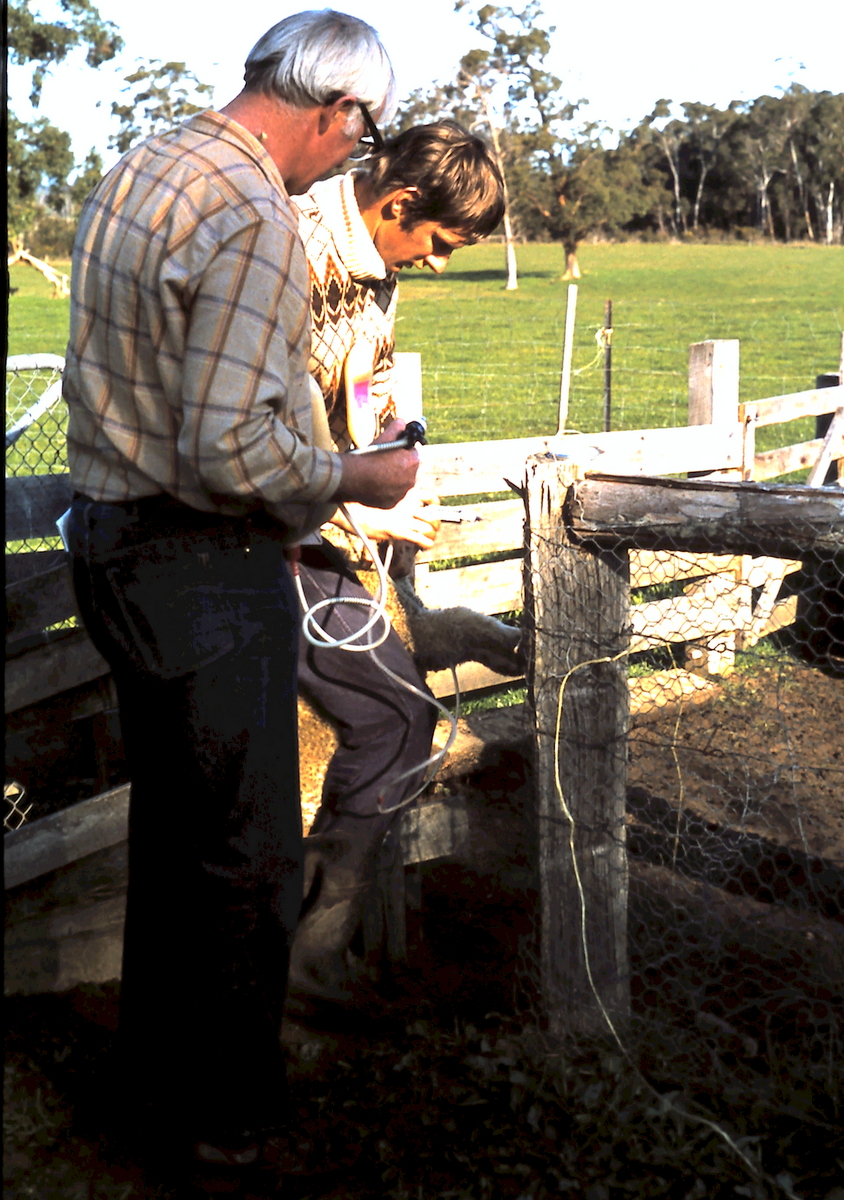
In the 1970s my husband and I bought a small farm nearby and ran a few sheep. On this particular day in about 1976 the lambs needed to be drenched for worms. As our sheep yards at that time were still in a state of disrepair and lacked a narrow race it was a bit of a task to catch the lambs in the rather large enclosures, so my dad thought it would be helpful if he brought his visitors over to help out. Dad, Uncle Arthur, the three young Smith cousins (Julie, Robert and James) and their friends (Michael and his two girls) arrived and were put to work.

It was pretty funny. The kids, especially the girls, were reluctant to get dirty. Very reluctant. And the lambs were lively and hard to catch and hard to hold if they were caught. There was a lot of squealing and the kids got very dirty. But we got the job done.

My cousins still talk about that day.


This blog is in response to Sepia Saturday's theme photo that shows a lady being carried across a stream. I didn't have any photos of a gentleman helping a lady but I did have these photos, scanned off slides, showing people helping out on a farm. They aren't sepia but they are nearly 40 years old. Yet it seems like just yesterday! This is for you, Julie.


Saturday, September 6, 2014

Sepia Saturday: Joy's pets


What an interesting theme photo for Sepia Saturday this week. The little girl is intriguing - she looks downcast, or maybe she has a cold.
No monkey photos in my collection but I do have quite a few photos of my husband's Auntie Joy when she was a child in the 1930s. She always had pets of various sorts, and still does.

Joy and Sulphur-crested Cockatoo
Joy and Australian Magpie
Joy, Galah and rabbit
Joy and rabbit
Joy, dog and lamb (and mum)

Friday, August 22, 2014

Sepia Saturday: Who is in the window?

The theme photo for this week's Sepia Saturday features fans, national costume, hidden meanings.


I've used the perfect photo that matches the theme in a previous post so instead I'm posting a photo of a wedding group. In it there are two ladies with lacy hats, hiding in the background. They are the mothers of the bride and groom.

Wedding group at Balmattum, 1897 - Margaret McKernan and Daniel Phelan
The mothers, Jane Phelan and Christina McKernan
I've already written a more detailed blog about this particular wedding of my husband's great-grandparents here and in it I posted a more formal photo of the wedding party. For the purposes of this week's theme I'll repost that photo now.

William Phelan and Margaret McKernan with her parents (Daniel and Christina)
at left and his parents (Daniel and Jane) at right.
So I'm trying to imagine the sequence of events. Did the photographer first line up the bridal party and parents for a formal photo? And did he then invite other guests to gather round for the more informal photo? If so, why did the two mothers disappear inside the house and look out the window? (The photos were taken at the bride's home.) Did the photographer instruct them to stand there? If so, why didn't he make sure the groom's father was in the photo as well as the bride's father? Were there two different photographers? A little mystery that will never be solved.


LinkWithin

Related Posts Plugin for WordPress, Blogger...