Friday, December 11, 2015

Sepia Saturday: The Church Army, WW1

When my husband's grandfather, Roy Phelan, was an Aussie soldier on leave in London he purchased a handful of postcards depicting the Church Army Soldiers' Hostel and posted them home. They show various rooms within the building that were used by soldiers on leave or recuperating from illness - the dining room, the recreation room, the bedrooms - and must have been popular because there are numerous images of the same postcards on the web. Roy may have stayed there as he was a man of faith and was also injured in 1918.

The hostel was set up by the Church of England in the Buckingham Palace Hotel and run by the Church Army. The Army also set up refuge huts in France.

Postcard of the Church Army Soldier's Hostel, Buckingham Palace Hotel
Soldiers in the canteen, Church Army Soldier's Hostel
An Australian called Canon David Garland (who was the architect of Anzac Day) talked about the Church Army in a speech in Australia 1917. This is an extract from that speech:
Extract from a speech by Canon David Garland, the architect of ANZAC Day, November 1917.
And this article was published in a Queensland paper in 1917. I found several similar articles in other Australian and New Zealand papers.

Brisbane Courier, 22 May1917
Roy also sent this photo home. It shows food canteens being carried to through  the trenches to soldiers serving on the Front. The text has been hand written but there's nothing written on the back.

WW1 Postcard. Carrying food up the front line on the Western Front.
This blog has been written in response to the Sepia Saturday prompt that shows a Salvation Army magazine photo of a soldier eating. You may find some more soldiers marching on their stomachs over at Sepia Saturday.


Friday, December 4, 2015

Thomas Round's 'brave death'

Thomas Round was a first cousin of my great-grandfather. His parents were William Round and Elizabeth Chaundy who lived at Prahran, Victoria. I've had Thomas' name on my tree for a few years but nothing else other than his birth and death dates because he died in Victoria when he was 15 years old.... I thought.

Last night I was Troving - just checking this and that, following random thoughts - when I landed on this newspaper article.

 The Telegraph, St Kilda, Prahran and South Yarra Guardian, 17 Jul 1875
That's a surprise!! Thomas didn't die in Victoria. He was lost overboard from the barque 'Formosa' off Cape Leeuwin, Western Australia. So, of course, I then searched Trove for more articles about the incident.

The first article I found was a poem that his father wrote. William Round, a law clerk, was a prolific contributor to newspapers (I've written about him here ) so the fact that he published a poem wasn't a surprise, and it really is quite poetic. The first poem has the footnote 'Europa' and the second 'Camellia'. I like the first better and can't work out if William was the author of the second.

The Telegraph, St Kilda, Prahran and South Yarra Guardian, 24 July 1875
IN MEMORIUM SACRA
THOMAS ROUND
(Who was lost overboard the barque “Formosa” off Cape Leuwin, on the 4th inst.)

Last year, ‘mid hearty farewells, the “Formosa” sailed away,
We wished our sailor boy God-speed, and a merry Christmas Day,
And a safe return from Shanghai, that glowing tropic land;
We little dreamed no more on earth to grasp his honest hand.

He sent us long, long letters across the ocean’s foam.
To tell us of the sights he’d seen, and how he longed for home,
Anticipation cheered our hearts and his; in two weeks more
The barque would enter Melbourne’s port, and Tom would come ashore.

We thought too slowly rolled the hours before should dawn the day
That brought us him for whom we made such preparations gay;
The children prattled merrily about their sailor brother,
His room was made all ready by his fond and happy mother.

The ship arrived in safety, but all too soon we learned
That he whose merry face we longed to see had not returned.
His fellow-sailors told the tale (a tale, alas, told of),
At duty’s call he faltered not, but hurried up aloft.

While ‘midst the heavy breakers the ship was madly tossed,
And in that tempest wild our sailor-boy was lost. 
Ah, bitterly we grieve for him, it seems too hard to bear,
Our darling boy for whose return we offered many a prayer.

But He holds the waves within the hollow of His hand
Knows what is best though first it seems so hard to understand;
He cheered his sailor-followers on the Lake of Galilee,
He stood beside our sailor-boy in that dread storm at sea.

And ’mid the grief of nature, we fondly realise
The thought that Tom has entered port – the port of Paradise,
His Saviour-captain gave the word, twas His divine behest,
Our sailor-boy has landed at that haven fair of rest.
EUROPA


The Telegraph, St Kilda, Prahran and South Yarra Guardian, 24 July 1875
According to several newspaper reports young Tom fell from the foretopgallant yard during a stormy night and was drowned. The ship was unable to turn around to search for him.

The Age, 16 July 1875

The Telegraph, St Kilda, Prahran and South Yarra Guardian 17 Jul 1875
The Tasmanian 24 Jul 1875
I broadened my search of Trove newspapers and found another article, published three years later, that details how the Tom Pearce who survived the famous shipwreck of the 'Loch Ard' went to the same school (Mr McKenzie's Prahran Academy) as young Tom Round.

The Telegraph, St Kilda, Prahran and South Yarra Guardian 27 Jul 1878
And finally, the reason Tom's death was registered in Victoria was not because that was his home state. It was because Melbourne was the first port of call after his death.

Thursday, November 19, 2015

Sepia Saturday: Cheeky lads

This week's theme photo for Sepia Saturday is delightful. I'm almost persuaded that those boys were all perfectly behaved, well-mannered, respectful, clean and never argued with each other or their parents. Almost.

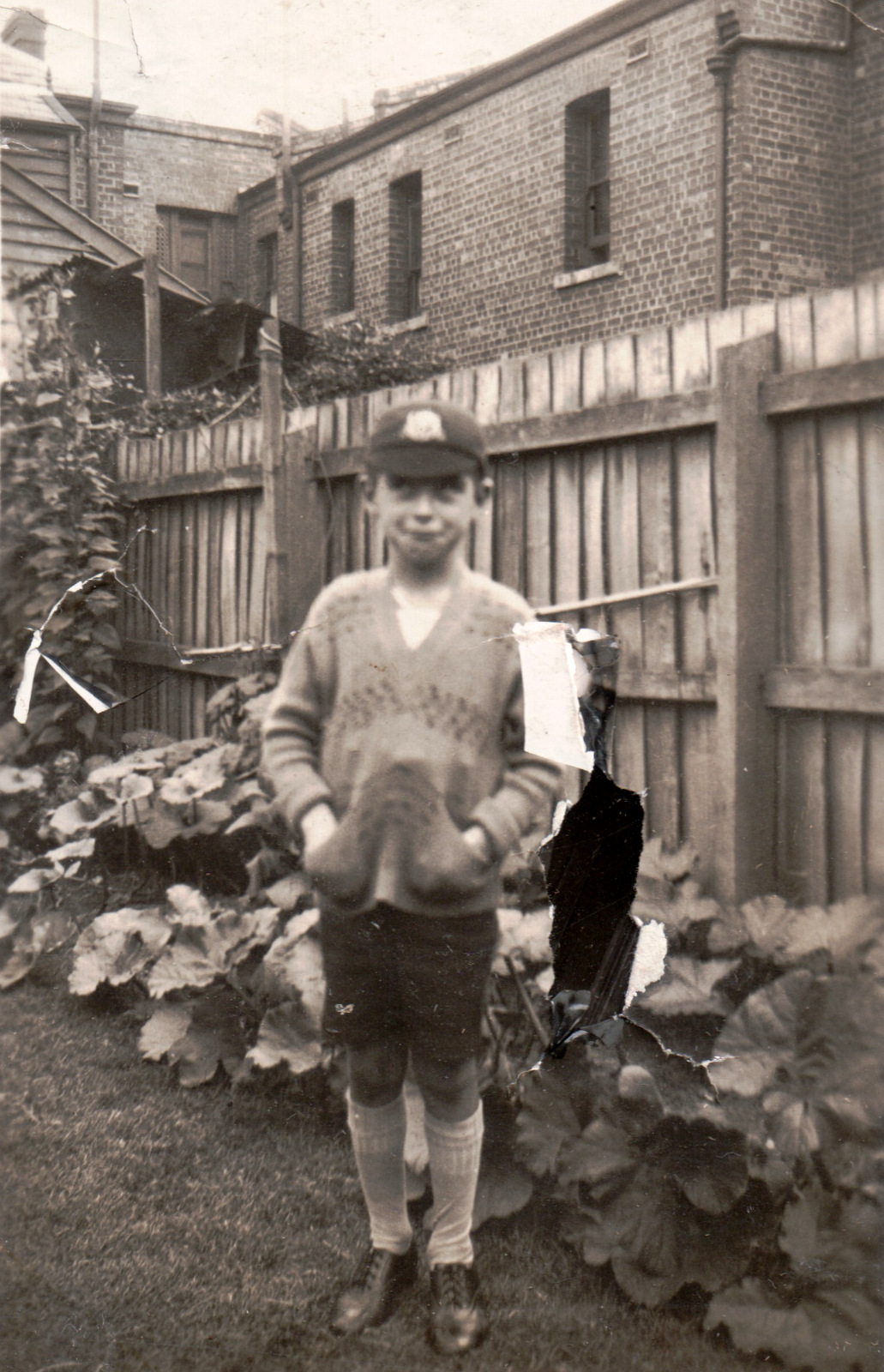
I've selected a photo from an album I purchased on the web, an album where there is no indication of names or locations but there are some very interesting (to me) snapshots of the 1930s in England. This particular photo has some damage and the background is more in focus than the boy but I like it. I like his facial expression, his saggy pockets, his dirty knees, his twisted socks, his polished shoes and his cap. Is he wearing braces under his jumper? I note that the lad's cap has a badge. Does that indicate that he's dressed for school?

Lad with a cap
So many of my Australian family albums have photos of kids in floppy hats and bonnets or they are bareheaded ("Take your hat off for the photo, Jack, and get your hands out of your pockets.") and I couldn't find a single one of a boy wearing a cap or playing games with caps. But I did find this photo that matches the lad in the photo above more than the theme photo. It's a holiday photo, probably a beach in Victoria. The lady at the back is Edie Sims who was a sister of my husband's grandmother. Don't the ladies look elegant in their woollen bathing costumes. Would their bathing caps have been waterproof or did they just try to keep their heads out of the water? I have another photo of the two ladies actually sitting in the water. I have no idea who the boys are but the one on the left in the floppy hat is obviously a cheeky one. And why aren't the boys wearing bathers?

Edie Sims (at the back) and others unknown.
If you want to see more lads in caps playing games you can head on over to the Sepia Saturday page.


Sunday, November 1, 2015

Sepia Saturday: Roy saw a ghost (on a postcard)

Roy Phelan was a country lad from Victoria, Australia so England (let alone the trenches of France) must have been a shock. He spent some time around Codford when he first arrived in Europe in 1918 and after the war he remained in England for about six months while he recuperated from a bad shrapnel injury. So he, like many other soldiers, was a tourist.

And, like many other soldiers, he bought postcards to send home or to keep as a record of his visit. For this post I've selected several of his postcards from a visit to Hampton Court Palace. None of these has been posted or written on the reverse. The Palace is outstanding even in the UK so I can only imagine how overwhelming it must have appeared to Roy.

Entrance to Vine and Gardener's Cottage, Hampton Court Palace. Postcard c1918.
South-East Front, Hampton Court Palace.
Is it possible that the lawn was dug up for vegetable gardens in WW!?
The third postcard is my selection for the Sepia Saturday theme of 'horror and Halloween'.


It is also Hampton Court Palace and shows the ghost of Jane Seymour. Apparently she was seen every night! I wonder if she still appears. Roy must have been intrigued because we don't have a lot of ghosts her in Australia and especially not in his home town of Mitiamo that was only about 40 years old at the time.

The Hampton Court Palace Ghost.
 Queen Jane Seymour's Ghost.
As seen nightly near the private stairway, leading to apartments formerly occupied by her.

******

Now, close your eyes if you are easily shocked. You've been warned.

This an old sepia photograph taken by a member of a photography club in Melbourne in the 1950s. It is one of a collection of photos donated to the Genealogical Society of Victoria.

Experimental photography and development techniques.
If you want to see more horrible photos sidle on over to the Sepia Saturday page.

LinkWithin

Related Posts Plugin for WordPress, Blogger...