Showing posts with label Australia. Show all posts

Thursday, January 1, 2015

Sepia Saturday: Scout Corroborree

Christmas 1962 was done and dusted  Several days later my husband, who was 14 years old at the time, travelled with a couple of other lads from Kerang in northern Victoria down to Essendon airport in Melbourne. They flew to Hobart in Tasmania (the island State off the south coast of Australia) to attend the Scout Corroborree, a camp based at Lea. It was a big national camp so there were boys and leaders from all over Australia and beyond. (Coorroborree is an Aboriginal word that means gathering for ceremonies and dancing.)

This is a postcard Phil sent home with an x marking the location of the camp. It was probably a card produced for the occasion but unfortunately he must have put it in an envelope because it doesn't have a postmarked stamp. I say unfortunately because philatelists are interested now because there was a temporary post office established at the camp and the collectors want the postmark.


3-1-63Dear Mum DadI'm now at the post office writing this. The post card is over looking the camp I put an ink mark where we are camping but the hills a lot steeper than it looks. Yesterday Wed. we went to hastings caves had a marvellous time. Tomorrow Friday I'm going to hobart and Mt Wellington. Douglas Westland [met] the Tysons yesterday, I was on tour then missed out.
It was a very well organised camp. Phil took photos between the numerous scouting activities and excursions, and these are some of them. I don't know what camera he was using but his photography skills needed a bit of attention! (Maybe he should have done the photographers badge. If there was such a thing.) The photos aren't great but I've googled and I couldn't find any others on the web so they may be of historical interest.


This post is in response to Sepia Saturday's theme photo. My photos feature flags and tents and uniforms so it almost matches :0
Happy New Year.


Saturday, May 10, 2014

Sepia Saturday: Tea time in the garden


The delightful theme photo for Sepia Saturday this week is of two sisters playing with blocks on a wicker table in the garden. It dates to about 1884.

My photos don't date from 1884, and neither are they sisters. My husband's aunt, Joy Phelan, and her friend, Norma Stewart, lived in the little town of Mitiamo in northern Victoria. It looks like they were enjoying a teaparty in the garden on a summery day. Or probably not, because that looks like real crockery to me, so maybe their mothers were having a cuppa and a chat. I hope they remembered to give the cute girls a treat. They both look so neat and clean, their hair neatly tied back in a bow and their socks folded down tidily. Could they have just been to church?

Joy Phelan and Norma Stewart, c1936
Joy Phelan and Norma Stewart

Friday, February 28, 2014

Sepia Saturday: Venus Baths


The theme photo for Sepia Saturday this week features people sitting on rocks. So I selected half a dozen photos to post ... and then decided to just go with one.

My parents, Mavis and Angus Wyllie, are in the photo - dad standing with his hands on his hips and mum sitting at his feet with me on her knee - as well as dad's mother, his two sisters (Barbara and Dorothy) and mum's sister, Betty, with my cousin Rex on her knee. So it's easy to date the photo to 1950.

Wyllies and Smiths at Venus Baths, Grampians 
The location is also easy. It's Venus Baths near Halls Gap in the Grampians, Victoria. Here's a modern photo taken in the same location.
Venus Baths, Grampains
For over a hundred years the Venus Baths has been a very popular spot, a short walk from Halls Gap and very pretty. I've been there lots of times because the Grampians mountain range has always been a family holiday and day visit spot, and a walk to the Baths was often included. In 1950 all of the people in the photo were living in and around the Minyip area of the Wimmera, an hour or so to the north. Later we all moved from Minyip but were still living close enough to visit the Grampians. We loved it and so did lots of other people. It's now a very popular National Park.


Nature has given the Grampians a bit of a battering in the last few years - several major fires including one a few weeks ago, and a severe rainstorm that damaged a lot of the major walking tracks and infrastructure. Venus Baths was also a casualty. The rock pools themselves were unscathed but the course of the creek was changed by rockfalls and slips, there was a lot of erosion and the track and footbridges were extensively damaged. The track was closed until everything could be repaired. I haven't been there since it was reopened but is on my list of things to do, and when I go I must remember to sit in the same spot for another photo.

Friday, November 8, 2013

Sepia Saturday: Yolngu bungul


The theme photo for Sepia Saturday #202 prompted me to dig out some photos from 40 years ago. They're not Sepia but it does seem like a long time ago nevertheless.

In 1971 and 1972 I lived on an island, in a village called Galiwin'ku on Elcho Island off the coast of Northern Australia. Galiwin'ku is home to the Yolngu people and the beach is an integral aspect of their culture for food, beliefs and fun.

I've chosen some images from that time that show the sandy beach as a dancing platform for fun and ceremony. The Yolngu dances are called bunguls (the u is pronounced as in oo in book) in that part of Australia, and the adults and children danced for fun almost daily. Someone would grab a didgeridoo or a piece of poly pipe, someone else would grab a pair of clapsticks or similar, the drone would start, the rhythm would start, the singing would start and the dancing would start. And somehow they all knew what dance to do and when to stop, without instruction. 

An important aspect of the bungul is being able to flick sand from both feet as you dance and of course the beach is perfect for that.

Children doing an impromptu bungul (dance), Elcho Island. Note the polypipe didgeridoo.
Teenage girls doing a bungul (dance), Elcho Island
Flicking the sand with feet, bungul (dance), Elcho Island

Adults performing a circumcision bungul, Elcho Island
There was no body paint for the impromptu dances but all of the ceremonial dances required a lot of preparation with body paints and decorations beforehand. In the photo below the children are painting their faces and bodies with foam from the surf, just for fun.

Children decorating their bodies with surf foam.
And lastly, a run for the sea, just for fun.


And finally. You have to watch this. About five years ago a group of dancers from Elcho Island (the chooky dancers) took Australia by storm when they performed Zorba the Greek dance Yolngu style. (I hope this works - I've never embedded a video before.)


You can do some more beach exploration over at Sepia Saturday.

Friday, October 4, 2013

Sepia Saturday: A clearing sale


This week for Sepia Saturday we're asked to highlight a photo that is 'blurred, scratched, undefined, and plain boring'. Easy peasy, I thought. But then I had trouble deciding on which of the many blurred and scratched photos to choose. Not one of them is boring to me because each captures a little slice of time in the life of my family.

I've chosen just one. After the war my parents, Angus and Mavis Wyllie, married and lived on a wheat farm at Laen, east of Minyip in Victoria's Wimmera district. I was three when they decided to sell the farm and move south to greener pastures at Homerton north of Portland on the coast. Dad wasn't a wheat farmer any more, he was a dairy farmer, and he didn't need the wheat farming equipment any more. So he held a clearing sale in February 1952. For several weeks prior to the sale there were advertisements in the paper.


Horsham Times, 25 January 1952 [Sourced at Trove]
Clearing sales are usually held on the property and items for sale are laid out in rows on the ground as shown in the photo. The sales are usually well-attended by neighbouring farmers looking for a bargain. The photo is faint and blurred but I like that it records that event and that it shows how flat and dry the Wimmera is. The farm at Homerton was undulating, lush, with a creek running the length of it and incorporated acres of natural bush as well as pasture. Thirty years later mum and dad held another clearing sale when they sold the farm at Homerton and retired.

Wyllie's clearing sale, Laen, February 1952
You can see more blurry photos over at Sepia Saturday.

Thursday, February 14, 2013

Sepia Saturday: Turtles on Galiwin'ku beach

In the olden days I was a teacher, and one of the schools I taught in was Shepherdson College at Galiwin'ku on Elcho Island in the Northern Territory, Australia. What a privilege. I was there for two years (1971-72), one of a small community of balandas (white people) in a community of yolngu (black people) living on the island just off the northern coast of Arnhem Land. Some of you may be familiar with the films Crocodile Dundee or Ten Canoes. They were filmed in the Arnhem Land as well.

The theme photo for Sepia Saturday this week includes a turtle, a soldier, a watch, a hat, a pipe. I've chosen the turtle.


The turtle is very important in the culture of many aboriginal peoples of Australia, and on Elcho Island even small children knew how to find turtle tracks in the sand to locate the eggs buried underneath and the hunters were very skilled at catching turtles for food (none of which was wasted).

The catch
Sand turtle
Turtle tracks
Baby turtle
OK, I've cheated a little. All of the above photos are from scanned colour slides. I've given them the sepia treatment with Picasa for the Sepia Saturday theme. Am I sacked from the group?

Saturday, February 9, 2013

Henley on Weeroona, Bendigo

I found these photos in a family album and decided to find out what they were about. I think I'm on the right track with my conclusions but am happy to be corrected.

Lake Weeroona, Bendigo (c1930s)
Lake Weeroona is an artificial lake on old mining land in Bendigo, central Victoria. It was made in the 1870s and has been very successful on the the whole, popular with residents and visitors alike. Apart from the times when there have been silting problems, low water supply, weeds, smelly water and other environmental issues. But today it has a cafe and restaurant, a walking/bike track, picnic facilities and a rowing club so it's a pleasant place to visit. The track around it is about one and a half kilometres long.

In the past (at least in the 1930s and I found one report from 1924) it appears they used to hold rowing regattas on the lake, called Henley on Weeroona, that included decorated craft (boat) competitions and I think that is what these photos are. I found several newspaper reports that mention the competition prize winners, none of whom are my family unfortunately. I suspect that these photos were taken in the 1920s rather than the 1930s but maybe someone more knowledgeable than me can recognise the hat styles.

The Argus, 5 Dec 1932
The Argus, 11 Dec 1933
The Argus, 26 Nov 1934

Friday, February 8, 2013

Sepia Saturday: Tennis anyone?

The theme for this week's Sepia Saturday had me tossed. Snow! There's not much of that around here in Australia, and never has been, so there aren't any family photos with snow in them. Ditto barrels, lamp posts or even a man wielding a shovel.


So I started thinking about the other meanings of snow, and came up with snowy white. Remember when everyone wore white when they played competition tennis every Saturday? Even the sandshoes were white, painted afresh each week.

Unknown tennis players, Mitiamo, Victoria

Shirley Alford, Mologa, Victoria

Thursday, January 31, 2013

Sepia Saturday: How does a country kid get to school?


This is the theme photo for this week's Sepia Saturday. Lots of choices - bicycles, boys wearing caps, bare feet, advertising signs. I think my photo from a family album fits the bill nicely.

It's maybe 1930, you live in or near a small country town in Victoria, you need to get to school every day. So, does mum get the 4-wheel drive out of the garage? Do you join a 'walking bus' group? Do you use public transport? None of the above. You walk, or ride your bike or saddle up your pony. The children look pretty happy. And look at that show-off in the very front!

School kids and their means of  transport, 1943. Bayunga, Victoria.
That's young master Johnston in front with his big bike, with a bag wrapped around the crossbar for him to sit on because he couldn't reach the seat. After school the teacher, Lena Alford, would sit him on the bike and give him a push to start him off and there would be someone waiting at home to help him stop and get off!

Wednesday, January 30, 2013

Trove Tuesday: In which Uncle William's house burns down

I know, it's Wednesday not Tuesday, but here's my entry for Trove Tuesday because I've solved a mystery using Trove.
William Thomas Wyllie
William Wyllie was a brother of my great-grandfather Robert. Both were wheat farmers near Minyip in the Wimmera district of Victoria, both had selected blocks of land when the government opened up the area for selection and both were married with young children. But in the 1890s Robert stayed and William left with his family to live and work in Melbourne. I never knew why.

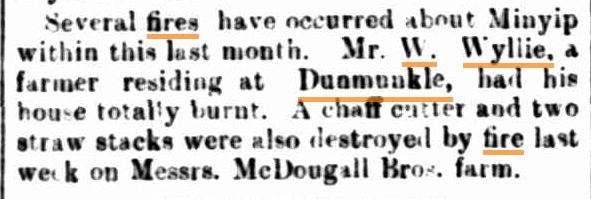
But then I found these reports on Trove. They've lost their house in a fire and they weren't insured. So with a family of four young daughters and a wife to support I'm guessing William didn't have many choices. I still don't know exactly when they moved but I'm sure the fire would have been a contributing factor.

The Argus, 30 Dec 1895
Horsham Times, 10 Jan 1896

William Thomas WYLLIE, son of William WYLLIE and Ann Megget CRANSTON was born on 20 Aug 1861 in McLaren Vale, South Australia, Australia. He died on 08 Oct 1935 in Mentone, Victoria, Australia. He married Naomi MILGATE, daughter of James MILGATE and Emily MOORE on 09 Nov 1885 in Dunmunkle, Victoria, Australia (Primitive Methodist). She was born on 21 Feb 1862 in Jacobs Creek, Lyndoch, South Australia, Australia. She died on 10 Dec 1945 in Mentone, Victoria, Australia. 

LinkWithin

Related Posts Plugin for WordPress, Blogger...