Showing posts with label Adelaide. Show all posts

Thursday, May 8, 2014

George Smith is a tourist in Adelaide

While George Smith was in Adelaide on his way to Western Australia (see previous blog) he had time to visit several tourist attractions.
19/3/1889 Went out to see the Gully Water Fall in the Mt Lofty ranges south of Adelaide and was much delighted with it and the rugged scenery around and the sea at sunset looked like an immense looking glass oval shaped at my feet. 
20/3/1889  Went out to see the celebrated sewerage farm North of Adelaide and was much delighted with it and on the farm was a crop of sorghum cutting sixty tons per acre also fruit trees and vegetables of great variety also ensilage pits in full work. Evening Chapel Grote St. 
21/3/1889 Stayed home and read Green and Walkers debate on Christianity versus Spiritualism. Afternoon went to see the model of the famous Strasburg Clock and Exhibitions Buildings.
 The first one was a waterfall. It's now called Waterfall Gully and it's 8 km east of Adelaide.

First waterfall, Waterfall Gully
The second was a sewerage farm! But remember, George was a farmer so he was very interested in the crops grown at the farm as well as the technology. And he wasn't the only visitor. Adelaide was the first in Australia to establish a waste-disposal treatment system so people from all around Australia as well as international visitors called in to check it out. It was opened in 1881.

A history of Sunnybrae, Donovan & Associates, 1993
And the next day George went to see a clock. The Strasburg Clock was on display at the Exhibition Buildings in Adelaide and is now in the Powerhouse Museum in Sydney where it is one of their most popular exhibits. George was impressed as well and he made notes in the back of his diary about aspects of its design. It had been built in 1888 by a young Sydney clockmaker,  Richard Bartholomew Smith (no relation), as a model of the famous clock in Strasburg Cathedral, Germany.

Strasburg Clock, Powerhouse Museum, Sydney
A description of the working of the Strasburg Clock
 (Teacher notes, Powerhouse Museum)
South Australian Advertiser, 29 March 1889
Finally, I decided to search for the Green and Walker debate on Christianity versus Spiritualism mentioned by George. And, to my surprise, found several references. The debate was held in Melbourne in 1878. George was a member of the Church of Christ so probably supported Mr Green's arguments.
Nineteenth Century Miracles, E H Britten [Google Books]

Monday, May 5, 2014

Trove Tuesday: In which the Adelaide Coffee Palace catches fire

In 1889 George Smith (William George Smith) was 25 years old, a wheat farmer at Dunmunkle  near Minyip in the Wimmera. His parents also lived at Dunmunkle and he was single, with five brothers and six sisters.


George's childhood was spent at Wangoom near Warrnambool on Victoria's coast and when he was about ten years old the family moved 250 km north to Dunmunkle. In 1889 he decided to go to Western Australia to find casual work, left home in late February and arrived back in early November. George wrote a diary while he was away but never said why he went or why he went to Western Australia. Maybe it was to earn more money, maybe it was just a bit of adventure before he settled down.

I decided to check the Trove resources against the diary entries and it has proven to be an interesting exercise. George travelled from Melbourne to Albany via Adelaide on coastal ships and then worked on the new Great Southern Railway being constructed from Albany to Beverly east of Perth. He also had time to visit a few tourist spots in the Adelaide and Perth areas.

For this Trove Tuesday blog I decided to check just one fact. George was staying in Hindley St, Adelaide and one night his sleep was disturbed when there was a fire in the Coffee Palace across the street.
22 March [1889]
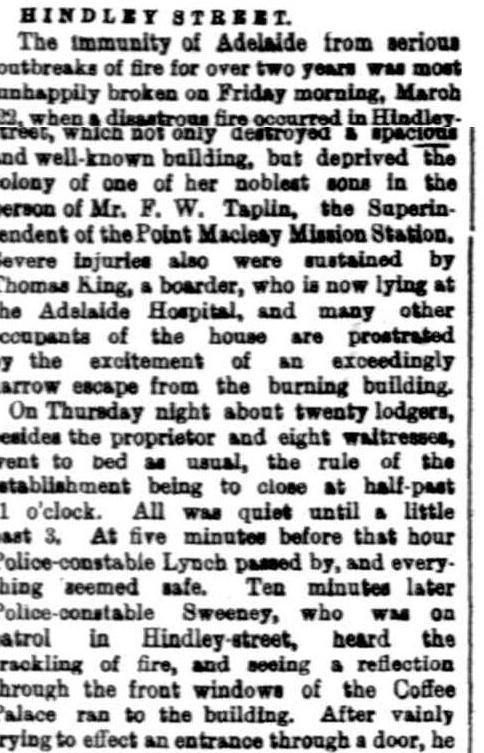
Early morning three a.m. scared with the alarm of fire and found it was the Adelaide Coffee Palace all on fire square opposite my bedroom window. One of our men suffocated to death another had his back broken and is dying recovering.
South Australian Register, 22 March 1889
Adelaide Fire Brigade, horse-drawn equipment and squad of firemen c1880.
[South Australian Library B28395]
The report that appeared in the paper the following day was more detailed. The cause of the fire at the Adelaide Coffee Palace was unknown but there was one fatality, Frederick W Taplin, and one badly injured lodger, Thomas King. The Adelaide Fire Brigade appeared promptly and the fire was quickly dealt with and restricted to the front of the building.

South Australian Register, 23 March 1889
From the map included in the report above it is clear that the Adelaide Coffee Palace was located in Hindley St next to Club House Lane. The building is no longer there. Coffee Palaces originated in the temperance movements at the end of the 1800s and offered accommodation and refreshments, designed to compete with hotels.

It turns out that Frederick Taplin, the man who died in the fire, was quite well known. He was in charge of the Aboriginal mission that his father had started at Point McLeay on Lake Alexandrina on the Coorong. There was an inquest into his death and a family notice of his death published in the papers. More details (an obituary almost) about Mr Taplin can be found at Trove in the South Australian Register 23 March 1889.

Evening News, Sydney (29 March 1889)
South Australian Register, 3 April 1889
There was a report of the fire published in a Western Australian newspaper. It provides a few more details.

Daily News, Perth (25 April 1889)
In May there was an auction of the furniture and effects of the Adelaide Coffee House.
The Advertiser, Adelaide (8 May 1889)
Great-grandfather George left Adelaide a few days later and sailed to Albany. That's a story for another day.

Saturday, December 14, 2013

Sepia Saturday: Grenfell St, Adelaide


A furniture van, a streetscape, a bicycle rider, an obelisk, a central pole - all good possible themes for this week's Sepia Saturday. But unfortunately I couldn't find a photo in my albums that I was happy to go with. So I am posting one from the Genealogical Society of Victoria's Flickr page of photos they hold in their research library. You can see more of their photos at this link.

It's a real photo postcard of the Grenfell St, Adelaide, South Australia, c1948. The postcard company was Valentine's. I chose it because it is a streetscape, it has a cyclist, a furniture van and a central pole.
Grenfell St, Adelaide
Grenfell St, Adelaide today [Google Maps] The tall white building is now dwarfed by its neighbours.

LinkWithin

Related Posts Plugin for WordPress, Blogger...