Showing posts with label Mologa. Show all posts

Thursday, December 4, 2014

Sepia Saturday: Ralph Alford is arrested

Remember when boys were enthralled by 'Cowboys and Indians'? Remember when the Saturday matinees in every town (before the era of TV) had serials like 'Hopalong Cassidy'. Remember when boys were given cowboy hats and holsters and guns for Christmas?

My husband's Grandpa Alford was happy to join in the fun when his grandsons, David and Roger Larkin, arrested him. Another little cousin, Joan Fisher, looks on. It must be about 1959. The place is Grandpa and Grandma Alford's dairy farm at Mologa in northern Victoria. All of the cousins have very happy memories of times spent at the farm.

"Hands up, Grandpa"
This post is in response to Sepia Saturday's theme photo in which there is a child in cowboy costume has lassoed his father. What will other bloggers do with the theme I wonder?

Saturday, February 1, 2014

Sepia Saturday: Ready for school


Suitcases or travel is the theme this week over at Sepia Saturday. Well, I can't find a family photo featuring a suit case but I have found a couple with another type of case. It's a school case. I used to have one of these in the 1950s but these photos are from a generation earlier.

Lena Alford ready for school c1930.
Lena (left) and Mary Alford ready for high school.

Tuesday, October 1, 2013

Trove Tuesday: Rhoda, Rhoda and Woodlands

I've blogged about Rhoda Andrew before. She lived a quiet life on her father's farm in country Victoria. For about a year in 1888, when she was 18 or 19, she wrote a diary that has now been transcribed. The diary has provided a number of useful clues in my family history research. Rhoda died of influenza when she was 30 and her mother died a few days later. Her father, who was also ill with the influenza, survived.

On 21 January 1888  Rhoda wrote about her mother, also called Rhoda.
Saturday Jan 21st [1888].This afternoon Kate took Mother out for a drive, the first time since her illness, I am so glad dear Mother is getting better and is able to get out a little; I do hope she will improve, I am sure.
 I was wondering what her mother's illness might have been but then I remembered that I had a copy of a newspaper cutting that someone in the family had kept. It was an obituary of Rhoda's mother that had been published in a church magazine. I've yet to find the source but I think it would have been Wesleyan Methodist or Methodist because the Andrew family were active members of their local church community. The obituary describes in quite a bit of detail the long-term ill health of Rhoda.
In Memorium (Mrs. Andrew)Since I knew the late Mrs Andrew she was somewhat of a recluse, through delicate health, mainly. During her whole life she was a fond and kind mother, a most devoted wife, very charitable and good to everyone; would divide her loaf with any who needed. Several of her babies died in infancy, and she grieved over the lost ones. She often seemed at death's door, from frequent attacks of asthma. Then another complaint gradually grew on her, which disabled her from walking much and getting to God's house regularly, also the necessary change of scene and fresh air. And being unwilling to let a doctor advise and help her she consequently suffered most severely in late years. Though the change of climate into the north improved her so much that there was little trouble with her chest, until that severe attack of influenza some years ago which weakened her so much that she never quite got over it. Not many knew how easily fatigued and how unfit for work she was. But patient and persevering how she would do the part when felt it her duty to do in the home. Through feeble health she did not in the outside public shine as brightly as many. She will, I feel sure, have stars in her crown. She leaves a good name to her children and grandchildren. May they through grace Divine follow in her footsteps and meet at God's right hand.
 M.A. Midgley[Church publication]
So what facts was I able to glean from the obituary?
  • She was sad because a number of her children died. I'm not surprised. She had ten children and only two of them survived childhood. After Rhoda's death at the age of 30 her sister Mary (my husband's direct ancestor) was the only surviving child.
  • She had frequent attacks of asthma
  • She had a severe attack of influenza 'some years ago'
  • She had another 'complaint' but refused to see a doctor
  • The family attended church
From other family information I know that the church they attended was the Woodlands Wesleyan at Central Mologa. The church was just up the road from the Andrew's farm that Rhoda's father and grandfather selected in the mid 1870s. I searched Trove for mentions of Woodlands Wesleyan church and found several articles. In 1877 the church was badly damaged in a wind storm - I think the community must have rebuilt it - and in 1887 they celebrated an anniversary.

McIvor Times and Rodney Advertiser (Heathcote), 22 Feb 1877
Kerang Times and Pyramid Hill Gazette, 8 Feb 1887
And the last one I found was about a bazaar to raise funds for a parsonage (possibly at Kerang).

Kerang Time and Swan Hill Gazette, 29 May 1888
Because the last newspaper item coincided with the year of Rhoda's diary I was able to check to see if she had written about the family's involvement in the fund-raising. And sure enough...
Friday May 4th. 
Mrs Hare and J. Wood came today, and of course the baby too, bringing their bazaar things.  
Friday May 11th. 
Mary went to Pyramid in the afternoon, Miss Baker came in the evening. We sat up till late at night, doing Bazaar work. 
 Thursday May 17th 
.Mary had Jane Hiscock over today, to help with some Bazaar work. Jane brought over her contribution.  
Friday May 18th. 
We went to Mrs Innocent's this afternoon for some fruit, and she was not at home, so went on for Miss Baker. We called again as we came back, found her at home this time, but could not get fruit tonight. Mrs I. is coming over tomorrow, so she said she would bring the quinces with her. Miss B. and Mary are working away tonight, for the bazaar, of course. Now I must go and help them, so no more for my "Diary", tonight.  
Saturday May 19th. 
Mrs Innocent came over in the afternoon. We were very busy, finishing baking cakes for the Bazaar. We got cleared away and swept up by night, so that's one good thing done.  
Monday May 21st. 
We washed today. In the afternoon Louisa Hare came up with the dolls she dressed for the Bazaar. 
Thursday May 24th.
Queen's birthday today, Bazaar opens today.  
Saturday May 26th. 
The Bazaar was a great success and I'm so glad. It is nice when a thing is a success.
And finally, for this blog, an entry where Rhoda again mentions her mother.
Monday June 4th. 
Mary and I took Mother for a drive this afternoon. Just up to the Church, we made a Catalogue of the books in the Sunday School Library. We moved the organ, to the other side of the Church, because it is warmer there for the winter, and swept out the Church. So we did a good afternoon's work. No more for tonight. Goodnight.
 And goodnight from me too. 


Friday, September 20, 2013

Sepia Saturday: Peace

There used to be a town called Mologa. It developed to serve the land selectors that started arriving in the 1870s. Now the shops, churches, school and post office have almost gone. But the War Memorial remains and it records the names of sons of those selectors who served in two world wars.

The two photos below have been taken from almost the same position and you can see in the first some of the buildings that used to be there in the 1920s. Great-uncle Ray Leed was killed in France and Great-uncle George Leed served in France. Both are named on the memorial. In fact for such a small community there are a lot of names on the memorial and this is repeated all over Australia.

Mologa war memorial (Alford family album)
War Memorial, Mologa (2013) Photo: Tim Fitzgerald
http://monumentaustralia.org.au/themes/conflict/ww1/display/32659-mologa-war-memorial
Most towns and cities in Australia erected memorials after the first world war and they still hold an important place in our culture. They are the focus point for the ceremonies that are held each year to celebrate the volunteers who left to serve overseas. And the communities also planted memorial avenues of trees, installed memorial boards in halls, clubs and workplaces and built memorial halls, bridges and so on. The war had a huge impact on the peace time that followed.

Not far away from Mologa is the town of Mitiamo. At the time of the first world war it was bigger and busier than it is now but it hasn't disappeared like Mologa has, and the community at Mitiamo also installed a memorial. I remember reading somewhere that this memorial is unusual in that it has a female sculpted figure - presumably she represents something or other and is not just there to look pretty. She seems to be holding a basket of fruit or vegetables.

Grandpa Roy Phelan (at right in the photo below) served in France in WW1 and his name is on the memorial. And so are the names of his two sons, Neil and Keith, who served in WW2.

Mitiamo war memorial (Phelan family album)
The photo above is interesting because it records the German machine gun that was also installed at the memorial. It is no longer there and I believe it was stolen.

Mitiamo memorial as it looks now.
More information here: http://en.tracesofwar.com/article/8643/War-Memorial-Mitiamo.htm
and here: http://www.rootsweb.ancestry.com/~ausvsac/Mitiamo_War.htm
The theme for this week's Sepia Saturday was peace, as in a campaign for peace, but I don't have any campaigners in my photo collection. So I went for the 'peace after war' idea.  I suggest you march on over to see what other Sepians have to say about peace.


Friday, August 30, 2013

Sepia Saturday: A brace of photos

The theme photo for Sepia Saturday this week includes three men, braces, newspaper, jazz musician and striped trousers. I've chosen some family photos of people wearing braces (suspenders).

Uncle Jack, standing left in the photo below, was a crack shot. But in Australia there really wasn't much to shoot at in the 1930s apart from kangaroos and rabbits. Rabbits were in absolutely plague proportions and a complete menace to the environment and the farming community but in the depression years they were an important source of food. But somehow I think this photo is just for fun. The caption reads 'The Big Game Hunters' and Jack and his mates, Malcolm and Mick, appear to have shot only two or three rabbits. All lived and farmed in Kooloonong in Victoria's Mallee. I saw Malcolm several months ago at Jack's wife, Lena's, 90th birthday and he had quite a few yarns to tell. He probably left out the best ones.
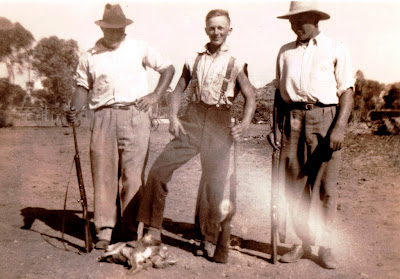
The Big Game Hunters (with two rabbits), Jack Larkin (left), Malcolm Macfarlane & Mick Murphy
 at Kooloonong, Victoria
And this is Jack's father-in-law Ralph Alford. Everyone loved Ralph. He was a farmer at Mologa and in this photo he's wearing his work clothes. Maybe he was just home for a cuppa and one of his daughters said 'Stand there for a minute dad.'
Ralph Alford, Mologa
Another of Ralph's daughters, Shirley, married the kid in the centre of the photo below. Neil Phelan turned 90 a month ago so we had another party! And there's Neil's uncle Gib with him, wearing braces and a tie so I think they've probably been to church.
Gibson Phelan, Neil Phelan (b. 1923) and Ina Phelan at Mitiamo, Victoria
And here are Neil's brothers, Doug and Keith. This time Doug gets to wear the braces but he probably didn't have a choice. Mum would have told him what to wear.
Doug Phelan and Keith Phelan, Mitiamo
And lastly, this is me about 1950. My mum used to draft the patterns and sew most of our clothes, and there are a few photos of us kids wearing shoulder straps of various kinds. These straps would have been buttoned on to the skirt. It looks grubby and so do my knees so I hope I hadn't just got back from church!
Yours truly
You can read more jazzy blogs on the theme over at Sepia Saturday's webpage.

Friday, February 8, 2013

Sepia Saturday: Tennis anyone?

The theme for this week's Sepia Saturday had me tossed. Snow! There's not much of that around here in Australia, and never has been, so there aren't any family photos with snow in them. Ditto barrels, lamp posts or even a man wielding a shovel.


So I started thinking about the other meanings of snow, and came up with snowy white. Remember when everyone wore white when they played competition tennis every Saturday? Even the sandshoes were white, painted afresh each week.

Unknown tennis players, Mitiamo, Victoria

Shirley Alford, Mologa, Victoria

Friday, January 18, 2013

Sepia Saturday: Red Cross calling

Each week over at Sepia Saturday a photo is posted as a theme for contributors to blog about.
This week's photo has a truck with someone standing on the tray and I immediately thought of a photo in my mother-in-law Shirley's album that also includes a truck with people standing on the tray.

In 1939 a number of young men from the rural area of Mologa in central Victoria volunteered to serve their country. It was the start of World War 2. Shirley's mother, Mary Alford, was the local Red Cross coordinator and put a lot of time and effort into fund raising, recruiting members and making items for the soldiers. It must have been a cause close to her heart because her brother was killed in France in the first World War. For several years a truck was decorated and driven in Pyramid Hill, a nearby town (possibly at the annual show). Shirley and her cousin Mary Leed dressed as nurses, and two local men, Ernie Boorn and Dave Williams, as soldiers.

Patriotic Red Cross truck, Pyramid Hill, c1939

Tuesday, October 23, 2012

Trove Tuesday: Private Leed K.I.A.


 Bendigonian 14 Sep 1916, p2
We know quite a lot about great-uncle David Ray Leed*, or Ray as he was known, because we have letters he wrote home from Egypt and France in WW1 as well as his enlistment papers from the National Archives of Australia.

But it seems there's always more. When I typed his name into the search box at Trove today I discovered that two months after his death two articles appeared in a Bendigo paper - one (above) included a photo and the other (below) a brief biography. His family lived at Central Mologa north of Bendigo. 

Bendigonian, 14 Sep 1916, p24
The telegram received by Ray Leed's mother.

P.S. The name RAY is actually a family name. It's the surname of his great-grandmother, Susannah RAY who was born in 1804 in Denford, Northhamptonshire, England.

*David Ray LEED, son of David LEED and Mary Ann ANDREW was born on 10 Aug 1893. He died on 16 Jul 1916 in France.
Military record: Enlisted 17 Jul 1915; Private 23 Battalion, 7th Reinforcement; Embarked 26 Nov 1915 on 'Commonwealth'; Killed in Action at Pozieres, Somme, France 15 Jul 1916; Buried Rue-Du-Bois Cemetery (Plot I, Row F, Grave 7), Fleurbaix, France.

LinkWithin

Related Posts Plugin for WordPress, Blogger...