Showing posts with label South Australia. Show all posts

Sunday, December 2, 2018

A convict-free colony please

Unlike every other state in Australia except Victoria South Australia was not founded as a convict colony. In 1834 the British Parliament passed the South Australia Act that decreed that the new colony would be convict free and in 1836 the first ships arrived with government officials and new settlers.

At some time in the early years of the settlement my husband's 4th great-uncles, Alexander and William Honeyman, travelled to Adelaide by ship from Tasmania. The brothers were born in Falkirk, Scotland and had travelled to Sydney, New South Wales in 1821 with their mother to join their father. (There is much more to this story but I'm cutting to the chase.)

The father had died by the time the family arrived and both boys were placed in an orphanage when their mother remarried. Details are vague but it appears that the boys later joined whaling ships that sailed out from Sydney and Hobart.

In February 1845 there was a petition, a memorial signed by South Australian residents, asking for a guarantee that the state of South Australia would remain convict free and it was published in the newspaper together with the names of the signatories.

South Australian 14 February 1845
On the list is one of the brothers, Alexander Honeyman, who was living at Port Adelaide at the time.

The irony is that the father of Alexander and William (and their sisters Annie and Margaret) was a convict!! William Honeyman Snr was transported to New South Wales in 1816 for robbery. And their older sister Annie had married a convict in Tasmania in 1828 (and died in childbirth the same year).

I suspect that if Alexander and William had been told that their father was a convict (he was in prison and then transported when the boys were just toddlers) they would not have talked about it because in those days a convict background was shameful.

There must have been a lot of people with secrets in the early days of colonisation.

Thursday, May 8, 2014

George Smith is a tourist in Adelaide

While George Smith was in Adelaide on his way to Western Australia (see previous blog) he had time to visit several tourist attractions.
19/3/1889 Went out to see the Gully Water Fall in the Mt Lofty ranges south of Adelaide and was much delighted with it and the rugged scenery around and the sea at sunset looked like an immense looking glass oval shaped at my feet. 
20/3/1889  Went out to see the celebrated sewerage farm North of Adelaide and was much delighted with it and on the farm was a crop of sorghum cutting sixty tons per acre also fruit trees and vegetables of great variety also ensilage pits in full work. Evening Chapel Grote St. 
21/3/1889 Stayed home and read Green and Walkers debate on Christianity versus Spiritualism. Afternoon went to see the model of the famous Strasburg Clock and Exhibitions Buildings.
 The first one was a waterfall. It's now called Waterfall Gully and it's 8 km east of Adelaide.

First waterfall, Waterfall Gully
The second was a sewerage farm! But remember, George was a farmer so he was very interested in the crops grown at the farm as well as the technology. And he wasn't the only visitor. Adelaide was the first in Australia to establish a waste-disposal treatment system so people from all around Australia as well as international visitors called in to check it out. It was opened in 1881.

A history of Sunnybrae, Donovan & Associates, 1993
And the next day George went to see a clock. The Strasburg Clock was on display at the Exhibition Buildings in Adelaide and is now in the Powerhouse Museum in Sydney where it is one of their most popular exhibits. George was impressed as well and he made notes in the back of his diary about aspects of its design. It had been built in 1888 by a young Sydney clockmaker,  Richard Bartholomew Smith (no relation), as a model of the famous clock in Strasburg Cathedral, Germany.

Strasburg Clock, Powerhouse Museum, Sydney
A description of the working of the Strasburg Clock
 (Teacher notes, Powerhouse Museum)
South Australian Advertiser, 29 March 1889
Finally, I decided to search for the Green and Walker debate on Christianity versus Spiritualism mentioned by George. And, to my surprise, found several references. The debate was held in Melbourne in 1878. George was a member of the Church of Christ so probably supported Mr Green's arguments.
Nineteenth Century Miracles, E H Britten [Google Books]

Monday, May 5, 2014

Trove Tuesday: In which the Adelaide Coffee Palace catches fire

In 1889 George Smith (William George Smith) was 25 years old, a wheat farmer at Dunmunkle  near Minyip in the Wimmera. His parents also lived at Dunmunkle and he was single, with five brothers and six sisters.


George's childhood was spent at Wangoom near Warrnambool on Victoria's coast and when he was about ten years old the family moved 250 km north to Dunmunkle. In 1889 he decided to go to Western Australia to find casual work, left home in late February and arrived back in early November. George wrote a diary while he was away but never said why he went or why he went to Western Australia. Maybe it was to earn more money, maybe it was just a bit of adventure before he settled down.

I decided to check the Trove resources against the diary entries and it has proven to be an interesting exercise. George travelled from Melbourne to Albany via Adelaide on coastal ships and then worked on the new Great Southern Railway being constructed from Albany to Beverly east of Perth. He also had time to visit a few tourist spots in the Adelaide and Perth areas.

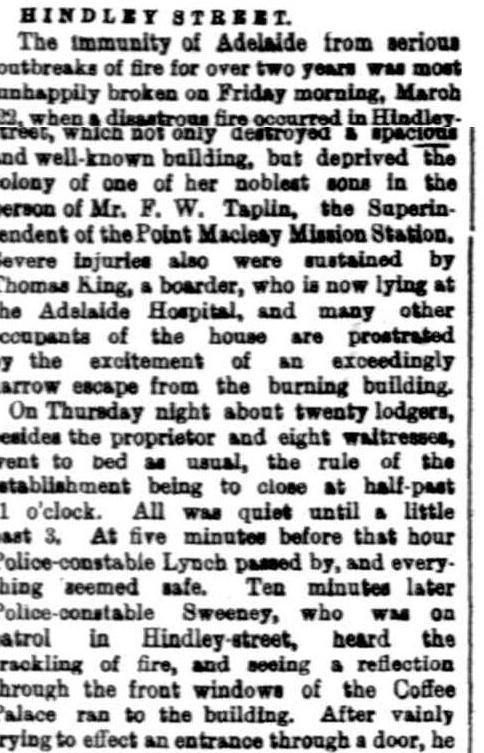
For this Trove Tuesday blog I decided to check just one fact. George was staying in Hindley St, Adelaide and one night his sleep was disturbed when there was a fire in the Coffee Palace across the street.
22 March [1889]
Early morning three a.m. scared with the alarm of fire and found it was the Adelaide Coffee Palace all on fire square opposite my bedroom window. One of our men suffocated to death another had his back broken and is dying recovering.
South Australian Register, 22 March 1889
Adelaide Fire Brigade, horse-drawn equipment and squad of firemen c1880.
[South Australian Library B28395]
The report that appeared in the paper the following day was more detailed. The cause of the fire at the Adelaide Coffee Palace was unknown but there was one fatality, Frederick W Taplin, and one badly injured lodger, Thomas King. The Adelaide Fire Brigade appeared promptly and the fire was quickly dealt with and restricted to the front of the building.

South Australian Register, 23 March 1889
From the map included in the report above it is clear that the Adelaide Coffee Palace was located in Hindley St next to Club House Lane. The building is no longer there. Coffee Palaces originated in the temperance movements at the end of the 1800s and offered accommodation and refreshments, designed to compete with hotels.

It turns out that Frederick Taplin, the man who died in the fire, was quite well known. He was in charge of the Aboriginal mission that his father had started at Point McLeay on Lake Alexandrina on the Coorong. There was an inquest into his death and a family notice of his death published in the papers. More details (an obituary almost) about Mr Taplin can be found at Trove in the South Australian Register 23 March 1889.

Evening News, Sydney (29 March 1889)
South Australian Register, 3 April 1889
There was a report of the fire published in a Western Australian newspaper. It provides a few more details.

Daily News, Perth (25 April 1889)
In May there was an auction of the furniture and effects of the Adelaide Coffee House.
The Advertiser, Adelaide (8 May 1889)
Great-grandfather George left Adelaide a few days later and sailed to Albany. That's a story for another day.

Saturday, January 18, 2014

Voyage to Australia: the ship 'Magdalena'

The ship Magdalena left Southampton harbour 23 May 1853, bound for Adelaide, South Australia. Captain Brenton was in charge and, apart from the crew, there was a surgeon superintendent, a handful of cabin passengers and about 360 government sponsored (assisted) immigrants. It arrived in Port Adelaide on 25 August 1853 after a voyage of three months.

Southampton docks
On board were my ancestors, William and Ann Wyllie  (or Wylie, as they were listed on the passenger list). William was 25 years old and Ann (nee Cranston) was 23. They had married three years earlier in Ann's home town in Muirkirk, Ayrshire, Scotland. Ann was about five months pregnant when they boarded and their first child was born in Black Forest, Adelaide about a week after they arrived.

I'd be interested to know how they travelled from Ayrshire to Southampton. Did they travel to Glasgow and then board a coastal ship? It's quite a distance. Why didn't they travel directly from Glasgow or Edinburgh? Even Liverpool is much closer. So I imagine there was quite a lengthy lead-in time to the actual departure, and we'll never know the reasons prompting them to make the decision to emigrate but I think it would have been economic. It wasn't gold prospecting because they stayed in South Australia for several decades before moving the Victoria.


Anyway, I digress. Back to the voyage itself. An Adelaide newspaper published a list of the passengers on board the Magdalena as well as the cargo she carried.
South Australian Register, 26 August 1853
According to the above report there were nine births and eleven deaths on board during the voyage. But another source states eight births and fourteen deaths. You can find a full list of the names (as well as a detailed passenger list) on the TheShipsList webpage but the cause of death is not known because the surgeon superintendent was inept at keeping accurate records. He was charged and convicted in an Adelaide court as detailed in the following newspaper report.

South Australian Register, 27 October 1853
There was also a small newspaper report of a lost item of luggage. I wonder how often luggage was lost or stolen after it was taken off the ship.


I have in my home a wooden chest that we use as a coffee table. We have no way of knowing for sure but I believe it is a chest that one of my ancestors used to carry their luggage on ship - and the Wyllies on the Magdalena are the most likely. My father remembers that when he was a child in the 1920s it was kept in the boys' bedroom and used to store clothes. 


And, lastly, a little anecdote. My Uncle Jim Wyllie told me that he met a man who told him that his father was on the Magdalena with William and Ann Wyllie, and he remembered William winning a raffle on the voyage. The prize was a case of apples which was shared among some of their fellow passengers.

Tuesday, July 30, 2013

Trove Tuesday: Dirty linen

In 1858 Esther Honeyman (nee Beringham) 'obtained a living by taking in washing' according to the newspaper report below. And that's not all! It appears that she was a prostitute (or a woman of low moral character as another report states, neglecting to comment of the moral status of the men who visited her). She was married to Alexander Honeyman, a great-great uncle of my husband, in 1852 in Adelaide, but at the time of this newspaper report she was living by herself at Port Elliot and said she hadn't seen her husband for seven years. Those numbers don't quite add up but it appears they separated soon after marriage.

Esther has had two children, one fathered by an 'aboriginal native' and one presumably fathered by John Dent who is objecting to being ordered to pay maintenance because he wasn't the only man who had visited Esther, hence the court case.

The Richmond River Express and Tweed Advertiser, 6 November 1858,
In November 1858,the same month as the court case, there is a report of the Destitute Board published in the paper. Esther Honeyman is granted 'relief' (presumably some sort of financial support), and the Board recommended that 'the eldest child (by an aboriginal native) should be taken off her hands'. The child was put into an Asylum. I wonder what sort of place that was and where it was.

South Australian Register, 2 Nov 1858
Four years later there is another newspaper notice about the older child. A Mrs Wauchope, of Salisbury, applied to take the Honeyman girl and 'promised to educate and prepare her for earning a respectable livelihood'. The girl would have been about six or seven years old at that time but I suspect that Mrs Wauchope would have had her working in the house and garden and at sewing from a very early age. [I believe, but haven't purchased the certificates to prove, that the girl is Esther Honeyman, born 1856 Port Elliot, who had two illegitimate children herself and died at Port Adelaide when she was 33 years old.]

Destitute Board report, South Australian Weekly Chronicle, 21 June 1862
Esther and Alexander Honeyman must have reconciled at some point because they later had two children at Port Elliot and are both buried at Nhill in Victoria where they selected land for farming. Prior to reading these newspaper reports I had entered the older child into my database as Alexander's - just goes to prove that one should never make assumptions - and didn't have a record of the second child at all.

Tuesday, November 27, 2012

Trove Tuesday: Ploughing a straight furrow

Wheel plough, Fife Folk Museum. (Image copyright Kim Traynor)
James and William Alford were brothers and they migrated together in February 1855 from Devonshire in England to South Australia. They were agricultural labourers in Devon and must have learned how to plough properly because both of them were very successful in ploughing competitions in South Australia and Victoria.

In the newspapers at Trove I've found quite a few articles detailing their successes and also those of William's sons, Thomas and George. Here's a taste.

James was living near Encounter Bay in South Australia when he entered this ploughing competition with a horse-drawn wheeled plough (similar to above) and took out first prize.

...
...
South Australian Register, 4 August 1855, p.3
 
Photo taken from Rosetta Head (the Bluff) west of Victor Harbor, showing the vicinity of the ploughing match.
The Fountain Inn mentioned above still exists. It's now a B&B called 'Yelki by the Sea'. James left South Australia and moved to Victoria. He also appears to have left farming and I can't find any other references to him as a ploughman. But his brother William was a farmer in Victoria and entered quite a few ploughing matches (Bendigo, Baringhup, Marong, Warragul, Buln Buln) as a competitor and was later a judge. Ploughing matches were very popular events in the 1800s.


Ploughing Competition. Powerhouse Museum collection (on Flickr)
Bendigo Advertiser, 25 June 1869
The Lennon plough used by Alford was made by Hugh Lennon's company in Melbourne. His single and double furrow ploughs were hugely popular and William Alford seems to have also liked them very much. [Ned Kelly also used one of his ploughs to make his metal armour.]

William ALFORD, son of Jacob ALFORD and Mary WEBBER was born in 1827 in George Nympton, Devon, England. He died on 15 Jul 1903 in Warragul, Victoria, Australia. He married Ann ROGERS, daughter of Philip ROGERS and Mary ? on 21 Mar 1851 in George Nympton, Devon, England. She was born in 1828 in Meshaw, Devon, England. She died on 05 Feb 1906 in Warragul, Victoria, Australia (At the home of George Henry Alford.).

James ALFORD, son of Jacob ALFORD and Mary WEBBER was born on 27 Jan 1832 in Devon, England. He died on 08 Sep 1895 in Ballan, Victoria, Australia. He married Honora FALLON, daughter of Owen FALLON and ? on 26 Oct 1855 in Encounter Bay, South Australia, Australia. She was born in 1833 in Sligo, Ireland. She died on 27 Feb 1880 in Parwan, Victoria, Australia. He married Elizabeth KELL, daughter of John KELL and Elizabeth AGNEW in 1882 in Victoria, Australia. She was born about 1845 in Ireland. She died on 29 Sep 1939 in Ballan, Victoria, Australia.

LinkWithin

Related Posts Plugin for WordPress, Blogger...