Showing posts with label ship. Show all posts

Saturday, January 18, 2014

Voyage to Australia: the ship 'Magdalena'

The ship Magdalena left Southampton harbour 23 May 1853, bound for Adelaide, South Australia. Captain Brenton was in charge and, apart from the crew, there was a surgeon superintendent, a handful of cabin passengers and about 360 government sponsored (assisted) immigrants. It arrived in Port Adelaide on 25 August 1853 after a voyage of three months.

Southampton docks
On board were my ancestors, William and Ann Wyllie  (or Wylie, as they were listed on the passenger list). William was 25 years old and Ann (nee Cranston) was 23. They had married three years earlier in Ann's home town in Muirkirk, Ayrshire, Scotland. Ann was about five months pregnant when they boarded and their first child was born in Black Forest, Adelaide about a week after they arrived.

I'd be interested to know how they travelled from Ayrshire to Southampton. Did they travel to Glasgow and then board a coastal ship? It's quite a distance. Why didn't they travel directly from Glasgow or Edinburgh? Even Liverpool is much closer. So I imagine there was quite a lengthy lead-in time to the actual departure, and we'll never know the reasons prompting them to make the decision to emigrate but I think it would have been economic. It wasn't gold prospecting because they stayed in South Australia for several decades before moving the Victoria.


Anyway, I digress. Back to the voyage itself. An Adelaide newspaper published a list of the passengers on board the Magdalena as well as the cargo she carried.
South Australian Register, 26 August 1853
According to the above report there were nine births and eleven deaths on board during the voyage. But another source states eight births and fourteen deaths. You can find a full list of the names (as well as a detailed passenger list) on the TheShipsList webpage but the cause of death is not known because the surgeon superintendent was inept at keeping accurate records. He was charged and convicted in an Adelaide court as detailed in the following newspaper report.

South Australian Register, 27 October 1853
There was also a small newspaper report of a lost item of luggage. I wonder how often luggage was lost or stolen after it was taken off the ship.


I have in my home a wooden chest that we use as a coffee table. We have no way of knowing for sure but I believe it is a chest that one of my ancestors used to carry their luggage on ship - and the Wyllies on the Magdalena are the most likely. My father remembers that when he was a child in the 1920s it was kept in the boys' bedroom and used to store clothes. 


And, lastly, a little anecdote. My Uncle Jim Wyllie told me that he met a man who told him that his father was on the Magdalena with William and Ann Wyllie, and he remembered William winning a raffle on the voyage. The prize was a case of apples which was shared among some of their fellow passengers.

Saturday, December 28, 2013

Voyage to Australia: the ship 'Violet'

A newspaper report indicates that the ship 'Violet' sailed from London on November 6, 1856 and then another report states that it was moored at Southampton until 20 December on demurrage.
Demurrage refers to the period when the charterer remains in possession of the vessel after the period normally allowed to load and unload cargo ). By extension, demurrage refers to the charges that the charterer pays to the shipowner for its extra use of the vessel. Officially, demurrage is a form of liquidated damages for breaching the laytime as it is stated in the governing contract (the charter party). The demurrage sometimes causes a loss to the seller as it increases cost of the total freight. Reference: Wikipedia

South Australian Register, 3 Mar 1856
South Australian Register, 7 Apr 1856
The Violet arrived at Port Adelaide, South Australia on 13 April 1856 after a voyage of about 122 days. On board were 237 emigrants including some of my husband's ancestors. John and Susannah ANDREW, their son John and his wife Rhoda with their young daughter Mary Ann, and John and Susannah's other son Daniel. (They are first on the list of passengers, below.) The captain of the ship was Henry Hall and the surgeon-superintendent was T R Tumner.

South Australian Register, 14 Apr 1856
The surgeon-general reported that three births and six deaths on board and that the immigrants were 'generally a well-selected class of persons'. The six passengers who died were James Williams (10 months), Joseph Richards (11 months), Thomas Strange (1 year), Johanna Healey (45 years), Alfred Ward (10 years) and Mary Ann Harper (2 years). Their dates of death and causes of death can be found at www.shipslist.com and you can also find there a full and detailed list of the passengers (including the maiden names of the wives).

There is a newspaper report of a number of the passengers being violent, drunk and disorderly on board the Violet. Some were taken into custody and fined - a good start to their new lives in the colonies.

South Australian Register, 16 Apr 1856
The Violet also carried cargo. Before she arrived the Adelaide newspapers published a list that must have been in one of the London papers, and another list after the ship docked.

South Australian Register, 4 Mar 1856
South Australian Register, 14 Apr 1856
John and Mary Ann (nee Andrew) Leed. Mary Ann was a child on the Violet.
The Andrew family had been living in Oundle, Northamptonshire when they decided to move to Australia. Their oldest son, William, was already living in the Geelong area of Victoria, and so was their daughter Hannah who had migrated with her new husband, John Warrington. It's a mystery why the Andrews decided to go to Adelaide rather than one of the Victorian ports because they certainly didn't stay in South Australia. They moved immediately to Inverleigh near Geelong, probably on a coastal ship, and later lived near Pyramid Hill in central Victoria. But that's a story for another day.

There is a certificate (the original is in the Pyramid Hill museum) that states that "Mary Ann Andrew, 13 months old, is free from measles and able to emigrate." It's dated 27 November 1855. So I think young Mary Ann must have had a bout of the measles that could have prevented them from sailing.

The Violet left Adelaide to sail for Singapore on 30 April. She carried mail for England.

The South Australian Register, 30 April 1856

Thursday, November 21, 2013

Voyage to Australia: The ship 'Rodney'

My husband's ancestors, William and Ann Alford (with their infant son William), and William's brother, James, journeyed from their homes in Devon to South Australia in 1855 on the ship called 'Rodney'.

Australian newspapers regularly reported news of ships departing England but as the news was gleaned from newspapers on ships that had recently arrived it was often months out of date and inaccurate. Relatives and friends waited anxiously in Australia for news of ship travel times and events - there would have been letters sent beforehand as the intending emigrants made travel preparations.

Cornwall Chronicle (Devonport, Tasmania), 24 Jan 1855
The Rodney left Plymouth 21 November 1854 and arrived Adelaide 20 February 1855. It carried 321 passengers. William Frazer (or Fraser) was the Master, John Brownfield the Surgeon-Superintendent and Mrs Morgan the Matron. According to a report in the Government Gazette 'the ship arrived in very good order-harmony and contentment prevailed on board.'

An Adelaide newspaper listed the passengers (our William and Ann are first on the list). It doesn't mention that there were six births during the voyage and seven deaths (all infants) but the numbers were published elsewhere in the paper the same day, and the names were published in the Government Gazette.

South Australian Register, 21 Feb 1855


The South Australian Government Gazette
Name
Age
Date of Death
Cause of Death
Where buried
Williams, Norris ?
1
December 7th 1854
Convulsions
at sea
Parry, Henry ?
1
December 19th 1854
Exhaustion
at sea
Park, Matilda
(Parkin)

inf
January 8th 1855
Diarrhoea
at sea
Ellery, George
1
January 12th 1855
Diarrhoea
at sea
Newton, Elizabeth
inf
January 19th 1855
Diarrhoea
at sea
Ellery, William
2
February 12th 1855
Measles
at sea
Trevithick, Mary A.
1
February 12th 1855
Diarrhoea
at sea


Name of Mother

Date of Birth
Sex of Infant

Watkins, Mary

December 24th, 1854
female

Harris, Celia

December 30, 1954
female

French, Ann

January 15th 1855
male

Comley, Sarah Ann

January 17th 1855
male

Walker, Elizabeth

February 15th 1855
female

Fleming, Johanna

February 17th 1855
female

The South Australian Register, 21 Feb 1855
The Rodney was at Port Adelaide for about four weeks and during that time one of the crew, Daniel Small, was charged by the ship's master, William Frazer, and fined for being drunk and disorderly.
South Australian Register, 28 Feb 1855
The ship sailed 20 March 1855 for Ceylon (Sri Lanka) and was carrying mail for England.
South Australian Register, 19 March 1855
The Alfords lived near the present-day Victor Harbor in South Australia for a year or two and then moved to, initially, Brighton in Victoria. William and Ann are buried at Warragul, Victoria and James is buried at Ballan, Victoria.

Monday, November 11, 2013

Voyage to Australia: The ship 'Susan'

In 1852 Robert Leed was 22 years old and working at Kinneil Iron Works at Bo'ness on the Forth, Scotland. His father, deceased, had been a Master and part owner of a schooner operating out of Glasgow. His mother remarried in August 1852.

Gold had been discovered in Australia so that may have influenced Robert's decision to buy passage on a ship to Australia. He paid his own way on a brig called Susan, one of only nine passengers on board. A brig has two square-rigged masts and is quite small compared with some of the huge clippers that sailed to Australia in the 1800s. She weighed 175 tons. Brigs were fast and maneuverable but had a reputation for being difficult to sail into the wind.

A brig
The Susan, with R D Munro as Master, departed Liverpool 24 January 1853. On 2 March she was sighted off the west coast of Africa by another ship called the Lima, and on 8 May she was seen west of Cape Leeuwin, Western Australia by Uncle Tom.
South Australian Register, 16 May 1853
The Argus, 25 May 1853
Hobson's Bay, Williamstown, Victoria [Source unknown]
After a voyage of four months the Susan arrived Hobson's Bay (Williamstown), Melbourne on 24 May 1853. There was a notice in Melbourne's main paper, The Argus, detailing the cargo she and several other ships had carried and the Sydney paper also listed the cargo.

The Argus, 25 May 1853
Geelong Advertiser, 26 May 1853
The Sydney Morning Herald, 30 May 1853
The brig stayed for a year or so, plying back and forth between Victoria and Tasmania carrying passengers and cargo. In August 1854 is was advertising accommodation to Mauritius and England.

The Argus, 11 Aug 1854
Geelong Advertiser and Intelligencier, 26 Aug 1854
In 1856 and 1857 there were several newspaper notices of 'the brig Susan' returning to Sydney port with sperm oil from whales, but it may not be the same ship.

Robert Leed went to the goldfields at Castlemaine and Eaglehawk, married and raised a family and died at the age of 57 from phthisis, a lung disease common with goldminers. He was a very good engineer, and worked for many years on large quartz-crushing machinery, but that's a story for another day.

Wednesday, November 6, 2013

Voyage to Australia: The ship 'Royal Charter'

It was Liverpool 1 October 1856. The passengers and crew were aboard including Daniel Phelan who had travelled across the Irish Sea from Ireland to join the Royal Charter as a passenger for Australia.

The crew were raising the anchor when a bad incident occurred resulting in severe injuries to some of the crew. The newspaper article doesn't state whether replacements were employed at the last moment (and you have to wonder about the fate of the injured men because there was no sick pay or worker compensation) but the ship left Liverpool and sailed down the Mersey the next day.
FATAL ACCIDENT ON BOARD THE ROYAL CHARTER.On the night of October 1st, as the crew, assisted by some of the riggers, were engaged in raising the anchor of the Royal Charter steamship, about to proceed to Australia, a sad and fatal accident occurred. From some cause or other the check had been taken out of the ratch of the patent capstan, and the weight of the anchor being suddenly brought into action, caused such a recoil as to throw the capstan bars about in a terrific manner. Four men were struck overboard, two of whom were soon picked up. Six others were very severely injured, one, it is feared, fatally. The sufferers were landed as speedily as possible, and they were immediately conveyed to the Northern Hospital. One of these, a laborer named John Gunn, who resided in a Court off Bond street, was found to have had his jaw broken, and also a compound fracture of the skull. He was in a most perilous state when taken to the hospital and was not expected to survive tho night. Another named Edward Atkins, a seaman on board the Royal Charter, who resided in Myle street, Toxteth Park, had his nasal bones broken, and received a very severe contusion of the leg. John Crossley, also a seaman, residing in Newhall street, received very severe contusions on the back and shoulder. He, like those previously named, remains in the hospital. The other three, named Thomas Ryan, Richard Butler, and James Kelly, labourers, were seriously hurt, the last named having his arm broken, after their injuries were attended to, by their own desire they were conveyed home. [Bendigo Advertiser 10 Dec 1856]
In an English newspaper I found reports of the inquest held on the body of John Gunning [it's written as John Gunn in the article above].


Liverpool Weekly Mercury, 4 Oct 1856
Daily Post, 3 Oct 1856
Capstan

Engraving of the ship Royal Charter, January 1856. Anglesey Archives, Wales
It was the second voyage of the Royal Charter and she was almost brand new. She was built in 1855 and as well as sails, was iron-hulled, had a screw auxiliary propeller and a steam engine powered by coal. She was famous in her day because she and other ships like the Lightning were competing to break travel-time records. This particular voyage from Liverpool to Melbourne took 40 days.

On board this voyage were over 400 passengers including Rev. Lillie. I mention him in particular because he a long, long letter about the voyage that was published in several newspapers. He must have driven Captain Boyce and the ship's engineer and others nearly mad over the months of the voyage because he provides a lot of detail about the technical side of the voyage. He was mightily impressed by the engine, the weather, the ship itself, knots per hour, compass readings, barometer readings. But he also provided some other gems of information.
... We steamed out of the Mersey against a westerly wind, on Thursday evening, the 2nd October. We put our pilot on board the barque Benin, bound for Liverpool, on the forenoon of the 4th, about twenty miles to the westward of Waterford....
... The importance of the screw as regards the health of the passengers was very apparent when passing through the calms to the north of the equator. With upwards of six hundred people crowded, as they necessarily must be, within the limits of a single vessel–carrying a large cargo besides–we should have been in great danger of epidemic disease had we been detained long in these hot and unhealthy latitudes. As it was, only slight symptoms of illness had time to manifest themselves among the children, of whom there were upwards of sixty on board. Two of very delicate constitution died during the hot weather, and one at a later period, of disease caught at the same time. The three were all very young. ...
... the first land we distinctly saw was a rock called Gough's Island, rising precipitously in the midst the South Atlantic to the height of 4000 feet, in 40 degrees 19 minutes south, 9 degrees 41 minutes west; we sighted this at the very hour that had been predicted to myself the day before by the captain. And last night, when the loam of the Australian land began to appear, and above all, when the beautiful light on Cape Otway first disclosed itself at the very time we had been led to expect it, a thrill of emotion passed through all on board, caused not more by the thought of having at length got within sight of our destination, than by admiration for the triumph of science and art, which had so strikingly signalised itself by our arrival at the given hour and place after a voyage of 13,000 miles through the trackless ocean....
... the captain has very kindly supplied me with an abstract from the official records of the voyage, and which will afford me the means of verifying my statements, or correcting any errors which through inadvertence I may have committed in the calculation. The barometer, thermometer, hydrometer, and hygrometer, used on board are all standard instruments, and have been supplied from Kew Observatory, for the purpose of carrying forward the combined system of meteorological and hydrographical observation in which the leading naval powers of Europe and America are now engaged...
 If you want to read his full report you'll find it at Trove's digitised copy of The Sydney Morning Herald, 16 Dec 1856. [Am I allowed to say the Rev. Lillie's sermons may have been a little dry? I could be wrong and I apologise in advance to any of his descendants reading this.]

The ship arrived at Hobsons Bay, Melbourne on 8 December 1856.


Several weeks later this letter of appreciation was published in the newspapers, addressed to Captain Francis Boyce, and signed by a number of the saloon passengers. (Surprisingly, Rev. Lillie's name is not on the list of signatories.)

Letter of appreciation, Sydney Morning Herald, 30 Dec 1856
Our passenger, my husband's ancestor Daniel Phelan, was employed immediately as a warder in the jail and got on with his life.

Three years and several voyages later the Royal Charter was returning to England with goods in its hold including a lot of gold bullion, and passengers carrying gold they'd mined on the Victorian goldfields. The ship was within cooee of home, just off the coast of Wales, when it was struck by a very bad storm (now known as the Royal Charter Gale) and shipwrecked. There are lots of webpages about the wreck (including a Wikipedia entry) because about 450 people died and only 39 people survived. (It is said that a number of people drowned because they were carrying their gold rather than leaving it on the ship.) Charles Dickens wrote about it in The Uncommercial Traveller, it was featured in an episode of Who Do You Think You Are because Monty Don's ancestor was one of the passengers who died, and the Meteorological Office started to issue gale warnings as a result of the shipwreck. There is even a song written about it called 'Isaac Lewis' (you can see it on YouTube).

Friday, November 1, 2013

Voyage to Australia: The ship 'Dirigo'

Jane Phelan nee Welsh
My husband's ancestor, Jane Phelan nee Welsh, travelled to Australia on the ship Dirigo  in 1859 to join her husband, Daniel Phelan. I have no proof but, according to information on their son's birth certificate, Daniel and Jane had married in Ireland about a month before he migrated to Australia. He arrived in Melbourne, Victoria in December 1856 on Royal Charter and was employed immediately as a warder in the prison. (I'll blog about Daniel and Jane another day - he worked always as a warder at Pentridge Prison in Coburg and the family lived nearby.) I don't know why Jane didn't travel to Australia with Daniel, and probably never will know. Maybe Daniel had already booked his passage, or his employment was pre-arranged and he had to earn enough to pay for Jane's passage. In 1856 Daniel was 26 years old and Jane was 18.

Great-aunt Ina told me that Jane's ship was 'shipwrecked' on the voyage to Australia and the Nominal List of passengers seemed to support that. The Dirigo left Liverpool on 28th November 1858 and Milford Haven on 4th January 1859 and arrived in Melbourne 28th March 1859. What happened between Liverpool and Milford Haven (which is on the south coast of Wales)?

Sydney Morning Herald, 12 Feb 1859
Dirigo sailed from Liverpool and sought a safe harbour in Milford Haven after experiencing a storm in the Irish Sea.
The Star (Ballarat), 30 Mar 1859
Ovens and Murray Advertiser, 4 Apr 1859


Government Report with details of the Dirigo. Column headings: Ship, tonnage, contract price per adult, date of departure, date of arrival, number of days on voyage, Name of Surgeon Superintendent, number of immigrants (male, female, children under 14 male and female, total), deaths (ditto).
  http://www.theshipslist.com/ships/australia/1858-1859.shtml
So, it appears that shortly after the ship departed from Liverpool it was hit by a severe storm and was badly damaged. The top-masts were lost. The report in the Sydney Morning Herald provides more detail - 'the jib-boom, fore and main topmasts, foreyard and mizen top gallant mast' were lost. I have no idea what they are but it sounds bad. It must have been a terrifying storm for the passengers and Captain White did well to get them and his damaged ship into a safe haven.

The Melbourne newspaper, The Argus, also published a report in its Shipping Intelligence column. First I found the notice of arrival.
The Argus (Melbourne), 29 March 1859
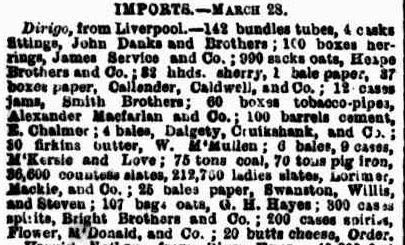
But then I remembered that I'd been told to always check the Shipping Intelligence column thoroughly so I scanned further down and found this report of goods imported on the Dirigo (the importers must have been getting very impatient because of the five or six week delay)...
The Argus (Melbourne) 29 March 1859
... and then even further down the column I found this report that provided me with more details about the storm. It states that the ship was 'off the south coast of Ireland' when she encountered a heavy gale and was 'obliged to put back to Milford Haven'.

The Argus (Melbourne), 29 March 1859
I wonder if the passengers were allowed ashore for the month they were in Milford Haven for repairs. I wonder where the new timber for the masts was sourced. Did the ship's crew do the repairs? From the newspaper notice above it appears that they had some 'considerable trouble' obtaining new masts.

So now we know that once they were under sail they made good progress until they rounded the Cape of Good Hope but then the winds were light and they slowed down. The length of the voyage was 120 days but that includes the time in Milford Haven.

Several newspaper articles also mention that the 2nd Officer, Henry Doyle, fell overboard from the poop and could not be rescued because the ship at the time was 'under double-reefed topsails'.


There is one more newspaper item relevant to this voyage of the Dirigo. It's an advertisement about the hiring of the immigrants. According to the disposal list on the ship's Nominal Roll our Jane was hired by J W Mansfield who lived in Swanston St, Melbourne but the date is 31 March, a day before the event detailed below, so maybe there were other arrangements as well. And I'm further confused by the fact that Jane was not a single woman, she was married to Daniel who would have been expecting her, so I'm not sure why she sought employment. Oh well, more mysteries to think about.

The Argus, 1 Apr 1859

LinkWithin

Related Posts Plugin for WordPress, Blogger...